
Imagine trying to navigate a day without your smartphone. Sounds impossible, right?
Our mobile phones have become indispensable, acting as our pocket-sized digital doorways to communication, entertainment, information, and commerce.
This profound integration into daily life has created an unparalleled opportunity for businesses: mobile marketing.
Mobile marketing is no longer just an option; it’s a critical necessity for any brand aiming to connect with its audience effectively.
By understanding the latest mobile marketing statistics for 2025, businesses can gain crucial insights into consumer behavior, market trends, and the most effective strategies to engage potential customers right where they are – on their mobile devices.
This comprehensive guide delves deep into the world of mobile marketing, providing detailed statistics, emerging trends, and actionable insights for businesses of all sizes.
Whether you are a seasoned marketer or just starting, this article will help you harness the immense power of mobile to drive engagement, boost conversions, and build lasting customer relationships.
Usage and Market Dominance
Mobile devices have truly reshaped our digital landscape. The sheer number of users and the amount of time they spend on their phones underscore why mobile-first strategies are no longer optional but absolutely essential.
Global Mobile User & Traffic Snapshot (Early 2023 – 2025 Projections)
| Metric | Value (Early 2023) | Projections (2025) |
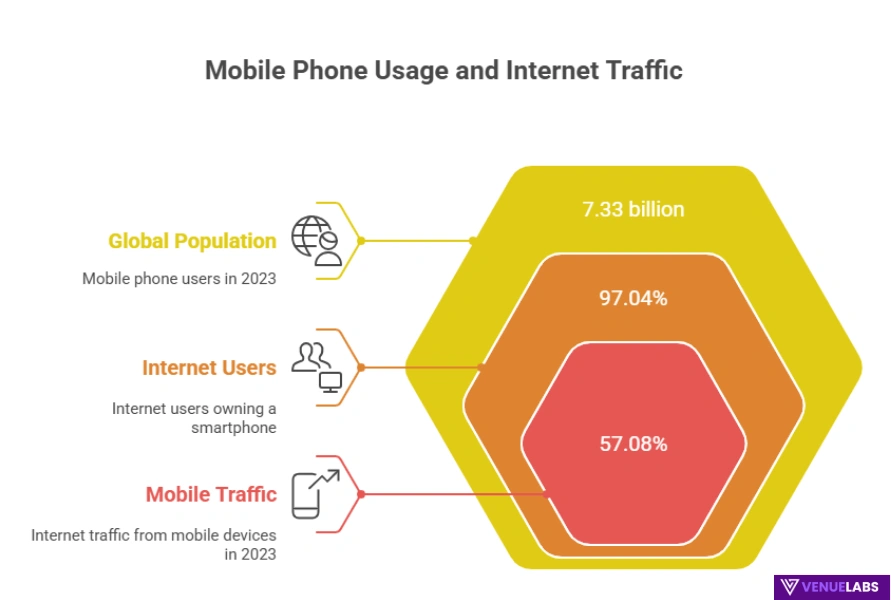
| Global Mobile Phone Users | 7.33 billion | Exceeds 18 billion devices |
| % of Global Population using Mobile | 90.93% | N/A |
| % of Internet Users owning a Smartphone | 97.04% | N/A |
| % of Internet Traffic from Mobile Devices | 57.08% | Predicted to increase by 25% (overall traffic) |
| Average Daily Mobile Usage | 4 hours 6 minutes | 5.4 hours (Average American) |
| % of Global Internet Traffic from Mobile Devices | N/A | 72% |
- As of early 2023, a staggering 7.33 billion people actively use mobile phones worldwide, representing over 90% of the global population. This nearly universal adoption highlights the unparalleled reach of mobile marketing.
- The number of mobile devices is projected to exceed 18 billion by 2025. This massive growth means even more opportunities for brands to connect with consumers.
- An impressive 97.04% of internet users own a smartphone, indicating that virtually everyone online is accessible via mobile.
- Mobile traffic already accounts for more than half of all internet traffic, hitting 57.08% in early 2023. This trend is accelerating, with projections indicating that 72% of all global internet traffic will come from mobile devices by 2025.
- Users spend a significant portion of their day on mobile phones. In 2023, the average daily usage was 4 hours and 6 minutes, and for Americans, this is projected to reach an astounding 5.4 hours daily by 2025, or over 1,900 hours a year.
- Android users alone spent over 4.1 trillion hours using mobile phones in 2022, showcasing the immense engagement on these devices.
- Mobile marketing is particularly effective for reaching younger generations. Nine out of ten millennials and Gen X individuals own a smartphone, making mobile a prime channel for these key demographics.
- Mobile’s influence extends to the business world. A high 80% of B2B buyers use mobile phones in the workspace, and B2B mobile marketing has impacted purchase behavior by a significant 60%.
These statistics powerfully demonstrate that mobile devices are not just pervasive; they are the primary gateway to the internet for most people, making mobile marketing a non-negotiable component of any successful strategy.
Also read about: Mobile Internet Traffic Statistics
Mobile Advertising and the Marketing Landscape
The shift to mobile-first consumption has profoundly impacted advertising spend and market dynamics. Businesses are rapidly reallocating budgets to capture audience attention on smartphones and tablets.
- Mobile advertising spending is soaring, with estimates exceeding $413 billion in 2024. Looking ahead, mobile ad spending is projected to surpass $216 billion globally in 2025, reaching a staggering $228.11 billion according to Statista.
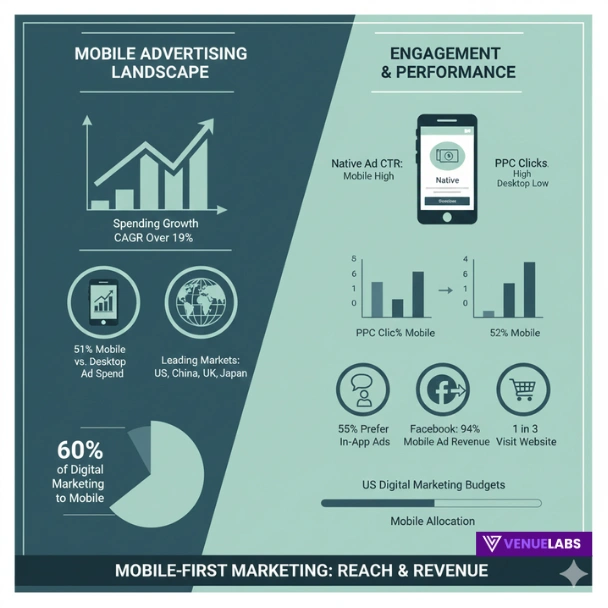
- The global mobile marketing market size was valued at $153.7 billion in 2023 and is predicted to increase by over 500% from 2020 to 2030, reaching $57.85 billion by 2030. This signifies a compound annual growth rate (CAGR) of over 19%.
- In the ongoing mobile vs. desktop debate, mobile platforms captured 51% of advertising spending in 2023, with 49% allocated to desktops. This marks a clear tipping point in budget allocation.
- The United States remains the leading mobile advertising market by ad spending, followed by China, the United Kingdom, and Japan.
- Out of the total digital marketing spending, a substantial 60% is now allocated to mobile.
- Native ads perform significantly better on mobile devices. The average click-through rate (CTR) for native ads on desktops is 0.16%, compared to an impressive 0.38% on mobile devices, showing higher engagement.
- A majority of Americans (55%) prefer watching mobile ads within apps rather than paying for the app itself, with 21% even stating they enjoy these in-app ads. This indicates a greater acceptance of non-intrusive mobile advertising.
- Facebook’s advertising revenues are overwhelmingly generated via mobile, accounting for 94% of its total ad income. This highlights the platform’s mobile-centric user base.
- One out of three users visits a brand’s website after watching a mobile ad, demonstrating the direct impact of mobile advertising on brand discovery and traffic.
- A strong 52% of all Pay-Per-Click (PPC) clicks now originate from mobile devices, emphasizing the need for mobile-optimized ad campaigns.
- In the U.S., 19% of total digital marketing budgets are allocated to mobile advertising, reflecting growing recognition of mobile’s performance.
These figures underscore that mobile is not just a channel; it’s the dominant force in the advertising world, demanding tailored strategies and mobile-first content creation.
Also read about: Mobile App Download Statistics
The Rise of Mobile Commerce (M-Commerce)
The convenience of shopping on a mobile device has transformed retail. Consumers are increasingly making purchase decisions and transactions directly from their smartphones, leading to a boom in mobile commerce.
- Mobile commerce is set to dominate online sales. In 2025, an estimated 72.9% of all online sales are expected to come from mobile shopping. This means nearly three out of every four online purchases will happen on a mobile device.
- Mobile users account for a significant 75% of traffic and 63% of sales on e-commerce websites.
- In 2023, mobile commerce already accounted for 8% of retail sales in the United States, with projections to rise to over 10% in 2025.
- Around 91% of Americans aged 18 to 49 say they have purchased items online using a smartphone.
- More than 40% of all online transactions now take place on mobile devices.
- Consumers spent nearly 500 billion hours using shopping apps in 2023, highlighting the immersive experience these apps provide.
- In-store shoppers heavily rely on their phones. A substantial 69% consider reading a product review on their phone rather than asking a store associate, and more than half use mobile phones to find online deals and discount codes.
- A significant 38% of shoppers who begin their product journey on mobile phones complete their purchase in-store, illustrating the hybrid nature of modern shopping.
- Customer perception is heavily influenced by mobile functionality. An important 59% of customers consider mobile shopping functionality important when choosing any brand or retailer.
- Mobile-friendly websites are crucial for success. Statistics show that 61% of customers are more likely to purchase from mobile-friendly sites. Moreover, 79% of people are more likely to revisit and/or share a mobile site if it is easy to use.
- Brand apps foster loyalty. A notable 46% of shoppers are less likely to explore other options when using a brand’s shopping app on mobile.
These statistics clearly illustrate that mobile commerce is the present and future of retail, requiring brands to prioritize seamless, intuitive, and engaging mobile shopping experiences.
Also read about: Marketing Automation Statistics
Key Mobile Marketing Channels and Engagement
Understanding where users spend their time on mobile devices is critical for effective mobile marketing. Certain apps and platforms stand out as prime channels for reaching and engaging audiences.
- YouTube holds the top spot for the highest number of users among all mobile apps, followed by Google, Google Chrome, and Facebook. This indicates that Google-powered platforms and social media giants are primary channels.
- A staggering 89% of YouTube traffic originates from mobile devices, underscoring its mobile-first consumption.
- In 2023, mobile users dedicated most of their time to Instagram, TikTok, and Facebook, highlighting the dominance of visual social media.
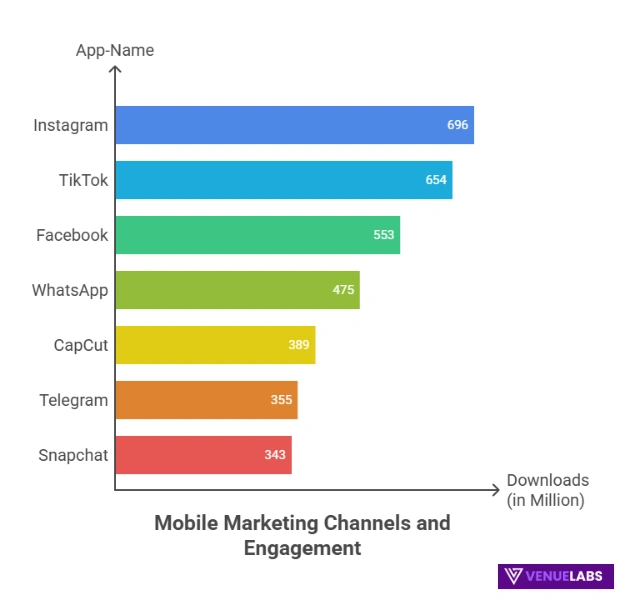
Most Popular Apps by Downloads (2023)
| App | Downloads (in millions) |
| 696 | |
| TikTok | 654 |
| 553 | |
| 475 | |
| CapCut | 389 |
| Telegram | 355 |
| Snapchat | 343 |
- The short video market has experienced explosive growth in recent years, making it a wise inclusion in any business’s mobile marketing plan.
- Email remains a preferred communication method, with 46% of mobile users preferring to be contacted via email.
- WhatsApp is the most popular messaging platform globally, offering immense potential for direct communication with customers.
- Push notifications are powerful drivers of engagement and conversions. They influence 20% of app opens and drive 15% of e-commerce conversions, proving their effectiveness in prompting action.
- Social media platforms are not just for browsing; they are significant drivers of mobile purchases. An impressive 42% of all mobile purchases originate from social media and e-commerce sites, highlighting the power of social commerce.
- TikTok continues to be the most downloaded mobile app globally, signaling the growing preference for short, engaging, vertical video content.
- The average smartphone user has over 40 apps installed but regularly uses only about 18. This emphasizes the fierce competition for screen time and the need for content to meet users in their most frequently used apps.
By focusing on these high-traffic and high-engagement mobile channels, businesses can maximize their reach and impact.
User Experience and Mobile-First Design
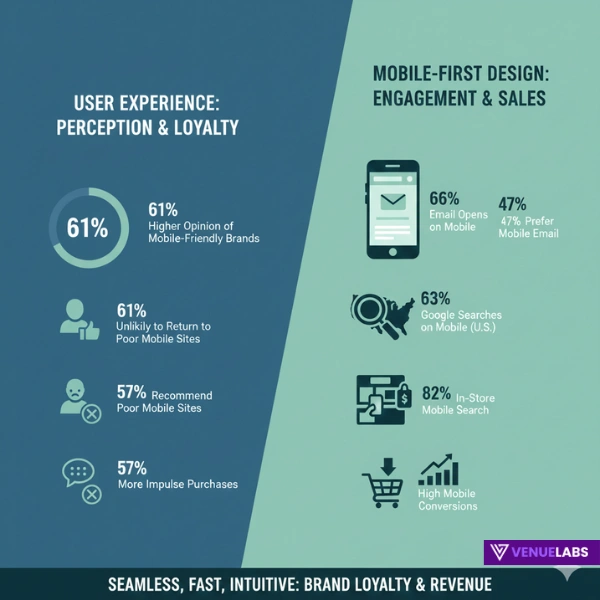
Beyond where users spend their time, how they experience content on mobile devices significantly impacts brand perception, engagement, and conversion rates.
- Customer opinion is directly tied to mobile-friendliness. A significant 61% of consumers have a higher opinion of brands with mobile-friendly websites.
- Mobile users have little patience for poor experiences. A high 61% of users are unlikely to return to a website they had trouble accessing on mobile, leading to lost trust, leads, and revenue. Likewise, 57% of users would not recommend a business with a poorly designed mobile site.
- Email marketing is overwhelmingly consumed on mobile. An astounding 66% of email marketing is opened on mobile devices, with 47% of people preferring to check emails on their phones. This means emails need short subject lines, clear calls-to-action (CTAs), and mobile-friendly visuals.
- Google searches are mobile-dominated. A striking 63% of Google searches in the U.S. occur on mobile devices, indicating that mobile is central to decision-making and information seeking.
- Even when in-store, mobile is crucial. An impressive 82% of mobile users search on their phones for details when physically in a store, comparing prices, checking reviews, or watching product demos.
- Mobile fosters impulse purchases. Mobile users are 40% more likely to make impulse purchases, driven by instant access, fast checkouts, and visually rich platforms.
These statistics confirm that a seamless, fast, and intuitive mobile experience is paramount for building brand loyalty, driving conversions, and ensuring positive customer interactions.
Quora & Reddit Insights: What Mobile Marketers Are Asking
Beyond official reports, online communities like Quora and Reddit offer a real-time pulse on the specific challenges and curiosities of mobile marketers and business owners. Here’s what users are frequently asking about mobile marketing in 2025:
- “How can I effectively target specific demographics (like Gen Z or Boomers) with personalized mobile marketing campaigns?” Users are looking for nuanced strategies to tailor content, channels, and messaging to distinct generational preferences on mobile.
- “What are the best tools and strategies for combating mobile ad-blockers and still reaching my audience authentically?” With a significant number of users employing ad-blockers, marketers are seeking non-intrusive ways to deliver value and engage without resorting to traditional, often blocked, ad formats.
- “How can I integrate mobile augmented reality (AR) into my marketing campaigns without a massive budget?” The promise of AR is exciting, but users want practical, cost-effective ways to implement it, especially for smaller businesses, to enhance product visualization and customer engagement.
- “What are the ethical considerations and best practices for collecting and using mobile user data for personalization and privacy?” As privacy regulations tighten, marketers are concerned about compliant data collection and transparent usage to build trust with mobile users.
- “How do I optimize my mobile video content for different platforms (TikTok, Instagram Reels, YouTube Shorts) to maximize engagement and ROI?” The rise of short-form video means marketers need platform-specific strategies for format, length, sound design, and content style to truly resonate with mobile audiences.
These questions highlight a marketer’s need for practical, ethical, and platform-specific guidance to navigate the evolving mobile landscape effectively.
Generational Divide: Tailoring Mobile Marketing
Understanding how different generations interact with mobile devices is crucial for creating targeted and effective campaigns.
Generational Mobile Behavior:
| Generation | Key Mobile Behaviors |
| Gen Z (ages ~11–26) | – 80% use smartphones as their primary device for online activity. <br> – 70% prefer short-form videos for brand discovery (e.g., TikTok, Reels). <br> – 60% have made mobile purchases directly through social media. <br> – 55% use voice search on mobile regularly. <br> – Average 4+ hours per day on mobile apps. |
| Millennials (ages ~27–42) | – 93% own a smartphone. <br> – 72% have purchased mobile devices in the past month. <br> – 74% regularly check email on mobile. <br> – 68% watch video content on mobile daily. <br> – 87% use messaging apps as their primary communication tool. |
| Gen X and Boomers (ages ~43–77) | – 90% of Gen X and 61% of Boomers own smartphones. <br> – 54% of Gen X make mobile purchases, compared to 34% of Boomers. <br> – 56% of Boomers check email primarily on mobile. <br> – 45% of Gen X use mobile banking apps regularly. <br> – Boomers prefer mobile for calls and essential tasks, with rising interest in video content and messaging apps. |
Gen Z is truly mobile-native, prioritizing short-form video and social commerce. Their engagement is often spontaneous and highly visual.- Millennials are heavy mobile users across various channels, including email, apps, and video, and they actively engage in mobile purchasing.
- Gen X and Boomers show significant mobile adoption, especially for essential tasks like email and banking, with growing interest in video and messaging, though their purchasing habits on mobile are less pronounced than younger generations.
Tailoring content, messaging, and chosen mobile channels to these generational preferences will significantly boost campaign effectiveness.
Emerging Trends in Mobile Marketing
The mobile marketing landscape is dynamic, with new technologies and consumer behaviors continually shaping its future.
- 5G Adoption and Enhanced Experiences: With 5G adoption reaching 45% of mobile users in developed markets, faster speeds and smoother streaming are becoming the norm. This improves user experience and raises expectations for rich media content, making high-quality mobile video even more critical.
- Augmented Reality (AR) Integration: Mobile AR is rapidly moving into the mainstream. Mobile AR users are expected to reach 1.7 billion by the end of 2025. A compelling 37% of consumers are more likely to purchase from brands using mobile AR, as it allows them to visualize products in their own space, making the shopping experience more immersive and persuasive.
- Voice Search Optimization: Voice search on mobile devices increased by 42% in the past year, indicating a significant shift towards hands-free, conversational queries. Marketers must optimize content for natural language and question-based searches to capture this growing trend.
- Short-Form Video Dominance: Platforms like TikTok, Instagram Reels, and YouTube Shorts continue to dictate mobile content consumption. Mobile video consumption increases by 100% every year, demanding short, attention-grabbing, vertical video content that entertains and informs quickly.
- Hyper-Personalization at Scale: Leveraging AI and data analytics, mobile marketing will become even more personalized, delivering highly relevant content and offers based on individual user behavior, location, and preferences.
- Ephemeral Content: Content designed to be temporary, like Instagram Stories or Snapchat, continues to drive urgency and immediate engagement.
- Integrated Mobile Wallet Experiences: Seamless integration with mobile wallets for payments, loyalty programs, and digital coupons will enhance convenience and drive conversions directly from the mobile device.
These trends highlight a future where mobile marketing is even more immersive, intelligent, and integrated into every aspect of the consumer journey.
FAQs About Mobile Marketing Statistics
1. How effective is mobile marketing in reaching modern consumers?
Mobile marketing is highly effective, as it targets users on their primary device, driving conversions, enhancing brand recall, and enabling real-time interactions.
2. What is the projected market size of mobile advertising in 2025?
The global mobile advertising market is expected to reach $228.11 billion in 2025, driven by the shift to mobile-first consumption and increased brand investment.
3. What is the impact of mobile marketing on e-commerce sales?
Mobile marketing will account for 72.9% of online sales in 2025, with mobile devices driving 75% of e-commerce traffic and 63% of sales.
4. Which mobile marketing channels offer the best return on investment (ROI)?
Channels like TikTok, Instagram, YouTube, mobile search PPC, and email marketing offer strong ROI through high engagement and personalized content.
5. How important is mobile optimization for businesses across all industries?
Mobile optimization is crucial for businesses as most online traffic and purchases now happen on mobile, directly affecting engagement and conversion rates.
Also Read:
- Artificial Intelligence Statistics
- Gemini Statistics
- Shopify Statistics
- Metaverse Statistics
- Live Streaming Statistics
Conclusion
The mobile marketing statistics for 2025 undeniably confirm that mobile is the dominant force in digital engagement.
From omnipresent usage and skyrocketing ad spending to the pervasive influence on e-commerce and the rise of mobile-first content, the smartphone is where customer attention resides.
Businesses that embrace a mobile-first mindset in their content creation, website design, advertising campaigns, and customer service will gain a significant competitive advantage.
Ignoring mobile is no longer an option; it’s a direct path to missing out on crucial engagement, valuable leads, and profitable conversions.
By understanding the data, adapting to emerging trends like AR and voice search, and prioritizing seamless mobile experiences, businesses can effectively reach, engage, and convert their target audience in the ever-evolving mobile-first world.
The insights from this article provide a robust framework for crafting impactful mobile marketing strategies that resonate with today’s connected consumers and drive success in 2025 and beyond.
Source: Statista, StatCounter



Comments
Be the first to leave a comment.