
Amazon Prime has transcended its origins as a simple shipping benefit to become a global powerhouse, an intricate ecosystem of services that underpins a significant portion of the modern digital economy.
For businesses, marketers, and curious consumers alike, understanding the intricate web of Amazon Prime statistics 2026 offers crucial insights into user behavior, market trends, and the immense opportunities within this ever-expanding subscription service.
This comprehensive article delves into the latest facts and figures, exploring membership growth, demographic shifts, revenue streams, and the powerful influence of Prime across various sectors, from e-commerce to entertainment.
From a relatively slow start after its 2005 launch, Amazon Prime truly ignited in 2011, transforming into one of Amazon’s most monumental success stories.
Today, it stands as the world’s largest paid subscription service, boasting an estimated 200-240 million subscribers across 23 countries.
This remarkable growth is not just about numbers; it represents a fundamental shift in how millions of people shop, stream, and engage with digital content.
Amazon Prime’s Global Reach
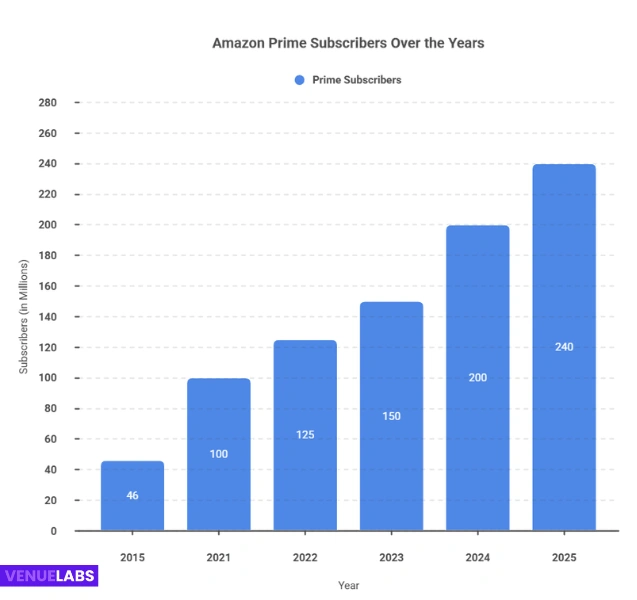
The sheer scale of Amazon Prime’s global subscriber base is nothing short of extraordinary. As of 2026, the service commands over 240 million subscribers worldwide, with some analyst estimates even pushing this figure towards 260 million.
This represents a significant growth trajectory, building upon 150 million members reported in 2019.
While Amazon’s last official update on precise subscriber numbers was in 2020, the consistent expansion of its services and geographical footprint strongly suggests a continued drastic increase in membership.
If Amazon Prime’s subscriber base were a country, it would rank as the 8th largest nation by population, underscoring its immense global footprint.
The service’s availability in 23 countries, including major markets like the United States, Canada, the United Kingdom, Germany, Japan, India, and Australia, highlights Amazon’s strategic global expansion efforts.
More recently, Amazon has intensified its focus on Europe, actively expanding its warehouse network and forging partnerships to establish wider distribution, leading to a noticeable increase in Prime subscriptions across the region.
Number of Amazon Prime Users by Year (Global)
| Year | Amazon Prime Subscribers (Millions) | Growth Rate |
| 2025 | 240 | 20% |
| 2024 | 200 | 33.33% |
| 2023 | 150 | 20% |
| 2022 | 125 | 25% |
| 2021 | 100 | 53.85% |
| 2015 | 46 | – |
The United States remains Amazon Prime’s largest individual market by far. Estimates from CIRP suggest that 184 million customers in the U.S. held an Amazon membership in 2024, an 8.2% increase from 174.9 million in 2023.
Statista provides a slightly more conservative figure of 180.1 million U.S. Prime users for 2024, reflecting a steady 3% increase from the previous year.
This consistent growth, seeing a rise of 54.1 million subscribers since 2019’s 126 million, underscores Prime’s enduring appeal and strong market penetration within the U.S.
However, experts predict that this growth rate may begin to slow over the next 2-5 years as Amazon approaches market saturation in the U.S., driving the company’s intensified focus on international expansion.
Amazon Prime Users in The United States by Year (Millions)
| Year | US Amazon Prime Users |
| 2025 | 185 |
| 2024 | 180.1 |
| 2023 | 174.9 |
| 2022 | 168.3 |
| 2021 | 161.7 |
| 2020 | 146.1 |
| 2019 | 126 |
| 2018 | 112.1 |
| 2017 | 99.7 |
Also read about: Netflix Subscribers Statistics
Demographics
Understanding the demographic breakdown of Amazon Prime members provides valuable insights for targeted strategies.
In the United States, Generation X consumers show strong penetration, with 35% holding an Amazon Prime membership.
Interestingly, over one-third of Baby Boomers and seniors also utilize Amazon Prime, highlighting its appeal across various age groups, likely driven by convenience and shipping benefits.
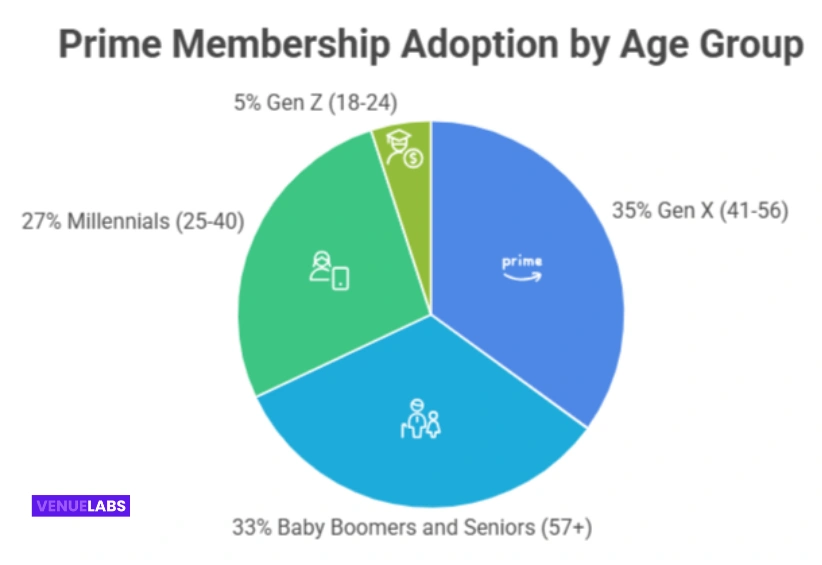
In contrast, Generation Z users currently show lower penetration, with just 5% having a Prime membership.
However, when focusing specifically on the Amazon Prime Video audience, the demographic skews younger.
Viewers aged 25-34 represent the largest segment at 32.63%, closely followed by 18-24 year-olds at 29.16%.
This suggests a divergence in usage patterns, where younger demographics are more drawn to the streaming entertainment benefits, while older generations might prioritize the core shopping advantages.
Overall, while a diverse range of demographics engages with Prime, young adults (18-34) exhibit the highest penetration for the full suite of benefits, with about 81% of U.S. internet users in this age group holding a paid Prime membership.
Amazon Prime User Penetration in The United States by Generation (Among Internet Users)
| Generation | Prime Usage Penetration |
| Generation Z | 5% |
| Millennials | 27% |
| Generation X | 35% |
| Baby boomers and seniors | 33% |
Also read about: Disney Plus Statistics
The Prime Revenue Machine: Sales and Subscription Growth
Amazon Prime is a formidable revenue generator for Amazon, although the company does not disclose revenue exclusively from Prime subscriptions.
Instead, it reports income from all its subscription services, which include Prime-related membership fees, digital video, audiobooks, digital music, e-books, and other subscription offerings (excluding Amazon Web Services).
As of Q1 2025, Amazon Prime’s total revenue (within the subscription services segment) has reached $11.5 billion, building on a strong $44.374 billion revenue for the full year 2024.
This indicates consistent performance and growth, with subscription services generating $11.7 billion in Q1 2025 alone, representing continuous expansion in Prime memberships and other subscription offerings.
Historically, Amazon Prime revenue has grown significantly. Starting at $2.76 billion in 2014, the subscription services segment steadily increased year after year, reaching $40.2 billion in 2023.
This figure more than doubled since 2017, consistently adding over $3 billion in revenue annually since 2018. The COVID-19 pandemic likely played a role in accelerating and maintaining subscriber growth during that period.
The recent increase in Prime fees (from $12.99 to $14.99 per month in the U.S.) is also expected to further boost revenue in the coming years.
Amazon Prime Subscription Services Revenue by Year (in billions USD)
| Year | Amazon Prime Revenue |
| 2025 (Q1) | $11.5 |
| 2024 | $44.374 |
| 2023 | $40.2 |
| 2022 | $35.22 |
| 2021 | $31.77 |
| 2020 | $25.21 |
| 2019 | $19.21 |
| 2018 | $14.17 |
| 2017 | $9.72 |
| 2016 | $6.39 |
| 2015 | $4.47 |
| 2014 | $2.76 |
Beyond direct subscription fees, Prime plays an essential role in increasing customer spending on Amazon’s retail platform. Prime customers spend an average of $1,400 per year on products, significantly higher than the $600 spent by non-Prime customers.
This demonstrates that the perceived value of Prime benefits, especially free shipping, encourages members to consolidate their shopping on Amazon, generating substantial additional retail revenue for the company.
Prime Day: A Retail Phenomenon
Prime Day, Amazon’s annual sales event exclusively for Prime members, has become a retail phenomenon, almost akin to a national holiday in the U.S.
Launched in 2015, this two-day event encourages Amazon and third-party sellers to offer massive discounts, often between 40% and 60%, on millions of products. The strategy is incredibly effective, consistently generating massive revenue and sales.
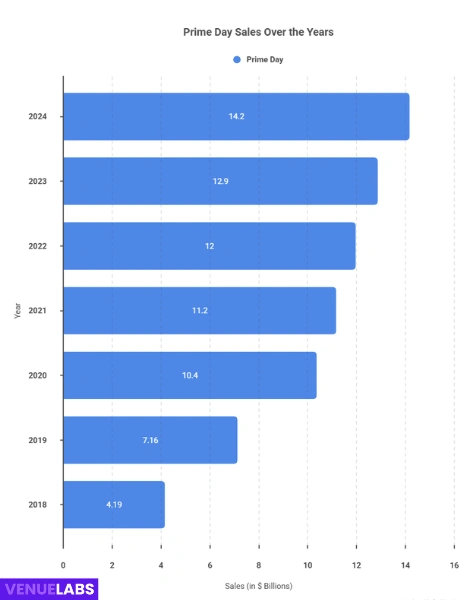
Prime Day 2024 set a new record for the event, generating $14.2 billion in total U.S. e-commerce sales across all retailers. This marked a 10.1% increase over 2023’s $12.9 billion in sales.
Since its inception in 2015, Prime Day sales have surged by over $13.3 billion, demonstrating its powerful and sustained impact on the retail calendar.
While the number of products purchased saw a slight decrease to 300 million in 2024 (down from 375 million in 2023), this was attributed to an increase in average order values and overall spending growth, rather than diminished interest.
Amazon Prime Day Sales Revenue by Year (in billions USD)
| Year | Prime Day Sales | Percentage Change |
| 2024 | $14.2 | 10.1% |
| 2023 | $12.9 | 7.5% |
| 2022 | $12 | 7.1% |
| 2021 | $11.2 | 7.7% |
| 2020 | $10.4 | 45.6% |
| 2019 | $7.16 | 70.7% |
| 2018 | $4.19 | 73.5% |
| 2017 | $2.41 | 58.6% |
| 2016 | $1.52 | 68.9% |
| 2015 | $0.9 | – |
A notable trend during Prime Day 2024 was the significant traction gained by “Buy Now, Pay Later” (BNPL) services, which accounted for $1.08 billion in sales, representing 7.6% of the total.
This indicates a growing consumer preference for flexible payment options during major sales events.
Amazon Prime Video: A Streaming Powerhouse
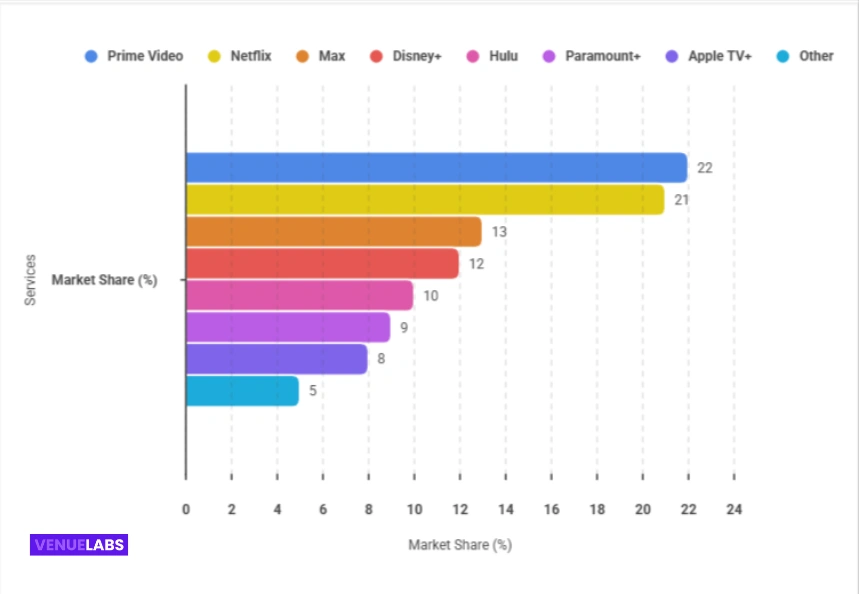
Amazon Prime Video has emerged as a dominant force in the highly competitive streaming market.
With a commanding market share of 22%, it slightly edges out Netflix (21%) to hold the largest share in the streaming market.
This leading position underscores Prime Video’s strong appeal and competitive advantage, especially given Netflix’s traditional dominance in the sector.
SVOD Market Share (Streaming Video On Demand)
| Service | Market Share |
| Amazon Prime Video | 22% |
| Netflix | 21% |
| Max | 13% |
| Disney+ | 12% |
| Hulu | 10% |
| Paramount+ | 9% |
| Apple TV+ | 8% |
| Peacock | 1% |
| Other | 4% |
The United States leads globally with 163.6 million Amazon Prime Video viewers, making it the country with the highest number of Prime Video users.
India follows as the second-largest market with 65.9 million viewers, while Germany (32.3 million), the United Kingdom (26.9 million), and Japan (16.2 million) round out the top five.
Prime Video’s availability in over 200 countries and territories highlights its extensive global reach, although full Prime membership benefits may vary by region.
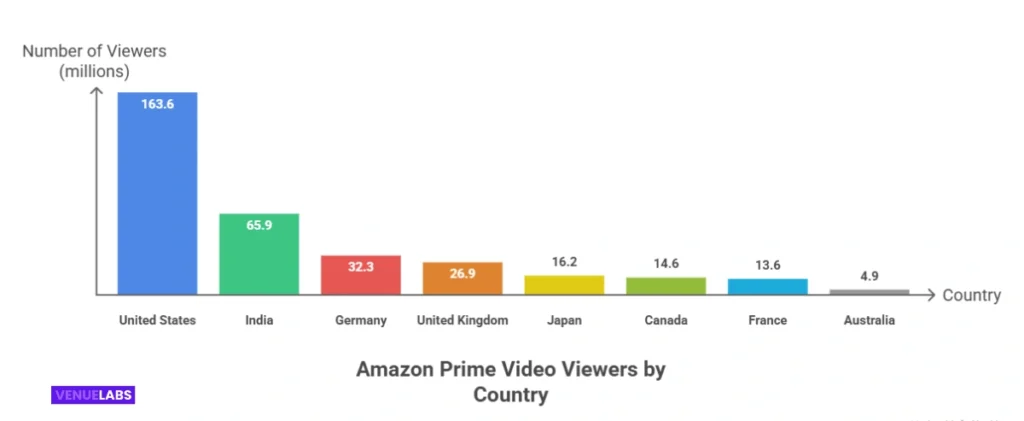
Amazon Prime Video Viewers by Country (Millions):
| Country | Amazon Prime Video Viewers |
| United States | 163.6 |
| India | 65.9 |
| Germany | 32.3 |
| United Kingdom | 26.9 |
| Japan | 16.2 |
| Canada | 14.6 |
| France | 13.6 |
| Australia | 4.9 |
Beyond traditional entertainment, Prime Video is making significant strides in sports broadcasting.
During the 2024 NFL season, Amazon Prime Video averaged 13.2 million viewers per game for its Thursday Night Football broadcasts, an 11% increase over the previous season.
Furthermore, Amazon Prime is integrating real-time betting features with FanDuel into its sports broadcasts, allowing users to sync accounts and access odds and bet tracking while watching games.
This convergence of streaming and interactive betting is transforming how audiences engage with sports, offering a more dynamic and personalized viewing experience.
Amazon Prime Music and Overall Amazon Revenue
While Amazon Prime Music offers a vast library, its user base saw a decrease from 80 million in 2023 to 52.5 million in 2024.
Despite this decline, it was the third most popular streaming platform in Western markets in 2023.
The exact number of paid subscribers remains undisclosed, as Prime Music also offers an ad-supported free version.
Amazon Prime Music Users (Millions)
| Year | Amazon Prime Music Users |
| 2024 | 52.5 |
| 2023 | 80 |
| 2022 | 74 |
| 2021 | 63 |
| 2020 | 55 |
| 2019 | 32 |
| 2018 | 16 |
Amazon’s Total Revenue by Year (in billions USD)
| Year | Amazon Revenue |
| 2024 | $638 |
| 2023 | $574.78 |
| 2022 | $513.98 |
| 2021 | $469.82 |
| 2020 | $386.06 |
| 2019 | $280.52 |
| 2018 | $232.88 |
| 2017 | $177.86 |
| 2016 | $135.98 |
Based on a strong Q1 2025 performance, with net sales of $155.7 billion (a 9% increase year-over-year) and a net income of $17.1 billion (a 64% increase from Q1 2024), Amazon’s 2025 revenue is projected to reach approximately $700 billion.
This robust growth, particularly in high-margin services like subscriptions, showcases not only revenue expansion but also improved profitability across the organization.
Amazon’s Revenue
| Segment | Q1 2025 Revenue | Projected 2025 Annual Revenue |
| North America | $92.9 | ~$372 |
| International | $33.5 | ~$134 |
| AWS | $29.3 | ~$117 |
| Total Net Sales | $155.7 | ~$700 |
What Users on Quora and Reddit Are Asking About Amazon Prime
Beyond the hard numbers, online communities like Quora and Reddit offer a glimpse into the evolving concerns and interests of Amazon Prime users.
A frequently asked question revolves around the value proposition of Prime, particularly as subscription costs rise.
Users often debate whether “Prime is still worth it” if they primarily use only one or two benefits, like free shipping, and ponder if the increasing price justifies the full suite of services.
Another common discussion centers on how to maximize Prime benefits. Users share tips and tricks for utilizing Prime Video, Prime Music, exclusive deals, and lesser-known perks, indicating a desire to extract the most value from their subscription.
There’s also curiosity about the future of Prime, with discussions on potential new services, the impact of increased advertising on Prime Video, and how Amazon plans to maintain subscriber growth in mature markets.
Concerns about data privacy and personalized recommendations also surface, with users questioning how Amazon collects and uses their data across Prime services.
Lastly, comparisons with other subscription services, particularly for streaming (e.g., Prime Video vs. Netflix/Disney+), are constant, as users evaluate where to allocate their entertainment budgets.
These discussions highlight that users are increasingly discerning and actively seeking to understand the full scope and long-term value of their Prime membership.
FAQs About Amazon Prime Statistics
How many Amazon Prime members are there globally?
Amazon Prime is estimated to have over 240 million subscribers worldwide, making it the largest paid subscription service globally.
What is the primary reason users subscribe to Amazon Prime?
The primary reason that 90% of Amazon Prime subscribers maintain their membership is the benefit of free shipping, often including same-day or next-day delivery options.
How much revenue does Amazon generate from its subscription services, including Prime?
Amazon generated $44.374 billion from its subscription services (which include Prime) in 2024, and based on Q1 2025 performance, this segment is projected to continue its strong growth.
What was the total sales figure for Amazon Prime Day in 2024?
Amazon Prime Day 2024 generated a record-breaking $14.2 billion in total U.S. e-commerce sales across all retailers, demonstrating its significant impact on the retail calendar.
Which streaming service holds the largest market share in the U.S.?
Amazon Prime Video holds the largest market share in the U.S. streaming market, capturing 22% of the audience, slightly surpassing Netflix’s 21%.
Also Read:
- Apple Statistics
- Upwork Statistics
- Link Building Statistics
- Screen Time Statistics
- Digital PR Statistics
Conclusion
Amazon Prime, with its extensive global reach of over 240 million subscribers and 180.1 million users in the U.S. alone, undeniably remains the world’s largest paid subscription service.
Its position as a foundational element of Amazon’s retail empire is further solidified by its financial strength, with subscription services reaching $44.374 billion in revenue by 2024.
The sustained success of Prime Day sales, generating $14.2 billion in 2024, perfectly reflects robust consumer engagement and the event’s powerful draw.
Beyond e-commerce, Prime’s influence extends deeply into entertainment, with Prime Video leading the U.S. streaming market at a 22% share, strengthening its competitive position against established players.
As Amazon projects an overall revenue of $700 billion in 2025, Prime remains a cornerstone, continually reshaping how consumers worldwide shop, stream, and connect.
The intricate Amazon Prime statistics 2026 collectively highlight its unparalleled growth, magnetic user appeal, and its powerful, multifaceted position across diverse sectors of the digital economy.
Source: Statista, Business of Apps
