
In a world increasingly concerned with digital privacy, DuckDuckGo stands as a beacon for those seeking an alternative to traditional search engines.
By 2025, the demand for privacy-focused tools continues to grow, making DuckDuckGo a key player in the evolving landscape of online search.
This in-depth article will explore the latest DuckDuckGo statistics 2025, helping you understand its impressive growth, user demographics, and how you can leverage its privacy features for your benefit.
The Rise of Privacy: Why DuckDuckGo Matters in 2025
Launched in September 2008, DuckDuckGo’s core promise has always been simple yet powerful: it does not collect your private user data.
This unique selling proposition has propelled its journey from a niche search engine to a formidable contender, especially as users become more aware of data tracking and its implications.
By 2013, DuckDuckGo crossed the remarkable milestone of 1 billion searches. Fast forward to 2025, and this privacy-centric search engine processes an average of nearly 3 billion search queries every month.
This sustained growth highlights a clear trend: people actively seek ways to protect their online anonymity.
Let’s dive into the fascinating statistics that paint a clear picture of DuckDuckGo’s position in 2025.
Also read about: Google Chrome Statistics
Key DuckDuckGo Statistics for 2025: A Snapshot
Understanding the core numbers helps us grasp the scale of DuckDuckGo’s operations and its impact.
- Monthly Search Queries: DuckDuckGo now handles an impressive average of 3 billion search queries per month.
- Global Market Share: Across all platforms worldwide, DuckDuckGo commands a 0.54% share of the search engine market, making it the 5th most popular search engine globally.
- US Market Share: In the United States, its presence is even stronger, holding a 1.96% share across all device types.
- US Mobile Dominance: Notably, DuckDuckGo ranks as the 2nd most popular search engine on mobile devices in the US, a significant achievement against giants.
- Workforce: A dedicated team of 200 employees works remotely from over 15 countries to keep DuckDuckGo running.
Daily Searches: A Steady Stream of Privacy-Conscious Users
DuckDuckGo processes around 100 million daily searches on average.
While daily search activity has remained relatively stable since 2021, not showing recent explosive growth, it represents a substantial and consistent user base committed to privacy.
This average number of daily queries nearly doubled (1.92x) since January 2020, demonstrating a powerful upward trend over the past few years.
DuckDuckGo Average Daily Searches (Since 2011)
| Date | DuckDuckGo Daily Searches (Millions) |
| January 2011 | 0.17 |
| July 2011 | 0.25 |
| January 2012 | 0.63 |
| July 2012 | 1.38 |
| January 2013 | 1.64 |
| July 2013 | 3.4 |
| January 2014 | 4.38 |
| July 2014 | 4.95 |
| January 2015 | 7.14 |
| July 2015 | 8.65 |
| January 2016 | 10.6 |
| July 2016 | 10.77 |
| January 2017 | 13.47 |
| July 2017 | 15.65 |
| January 2018 | 21.13 |
| July 2018 | 23.53 |
| January 2019 | 34.37 |
| July 2019 | 41.93 |
| January 2020 | 51.96 |
| February 2020 | 52.95 |
| July 2020 | 63.27 |
| January 2021 | 95.28 |
| July 2021 | 92.53 |
| January 2022 | 106.05 |
| March 2022 | 102.7 |
| July 2022 | 92.4 |
| September 2022 | 94.76 |
| November 2022 | 96.92 |
| 2024 (Estimate) | 100 |
(Note: DuckDuckGo stopped disclosing detailed daily traffic data in 2022. The 100 million daily searches are estimated from 3 billion monthly searches and divided by 30.)
Also read about: Bing Statistics
Annual Search Queries: A Decade of Remarkable Growth
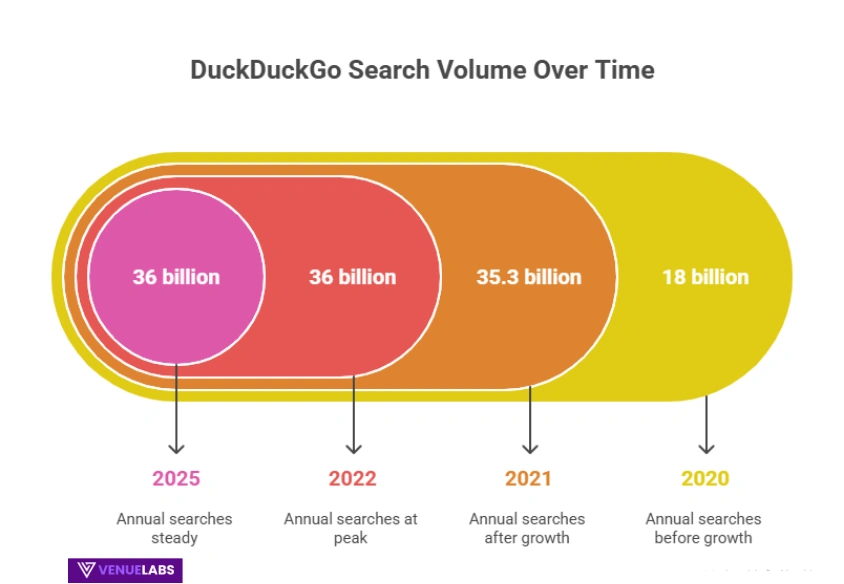
DuckDuckGo now processes an impressive 36 billion annual search queries.
Looking back, the trajectory of its annual searches reveals a story of consistent and significant expansion, reflecting a growing user base year after year.
DuckDuckGo Annual Search Queries (Since 2010)
| Year | DuckDuckGo Annual Searches (Billions) |
| 2010 | 0.016 |
| 2011 | 0.099 |
| 2012 | 0.496 |
| 2013 | 1.03 |
| 2014 | 1.97 |
| 2015 | 3.13 |
| 2016 | 4.09 |
| 2017 | 5.91 |
| 2018 | 9.2 |
| 2019 | 15.08 |
| 2020 | 23.65 |
| 2021 | 35.3 |
| 2022 | 31.21 |
| 2024 (Estimate) | 36 |
Global Market Share: Making Its Mark on the World Stage
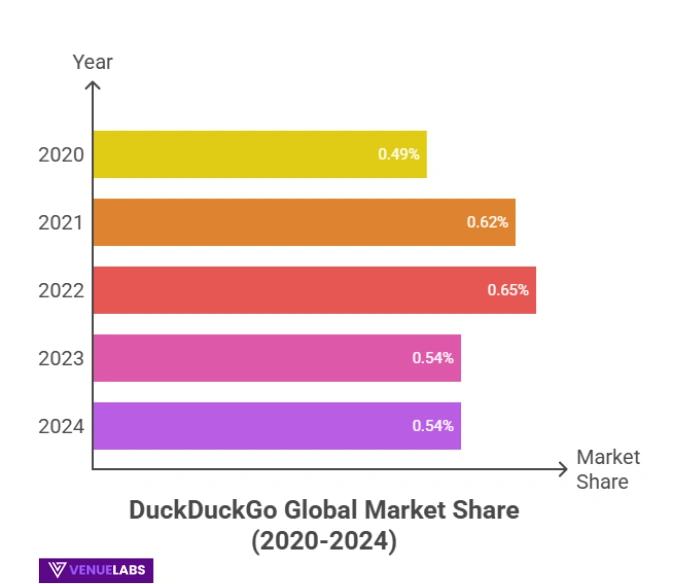
Globally, DuckDuckGo has carved out a respectable 0.54% search engine market share across all platforms.
This makes it the 5th most popular search engine worldwide, a testament to its appeal among privacy-conscious internet users.
While this figure might seem small compared to the market leader, it represents consistent growth until 2022, after which it slightly declined but stabilized.
DuckDuckGo Global Market Share (Since 2012)
| Year | DuckDuckGo Market Share |
| 2012 | 0.01% |
| 2013 | 0.01% |
| 2014 | 0.04% |
| 2015 | 0.11% |
| 2016 | 0.12% |
| 2017 | 0.18% |
| 2018 | 0.29% |
| 2019 | 0.42% |
| 2020 | 0.49% |
| 2021 | 0.62% |
| 2022 | 0.65% |
| 2023 | 0.54% |
| 2024 | 0.54% |
Desktop and Mobile: Different Battles, Different Strengths
DuckDuckGo shows varying strengths across different device types.
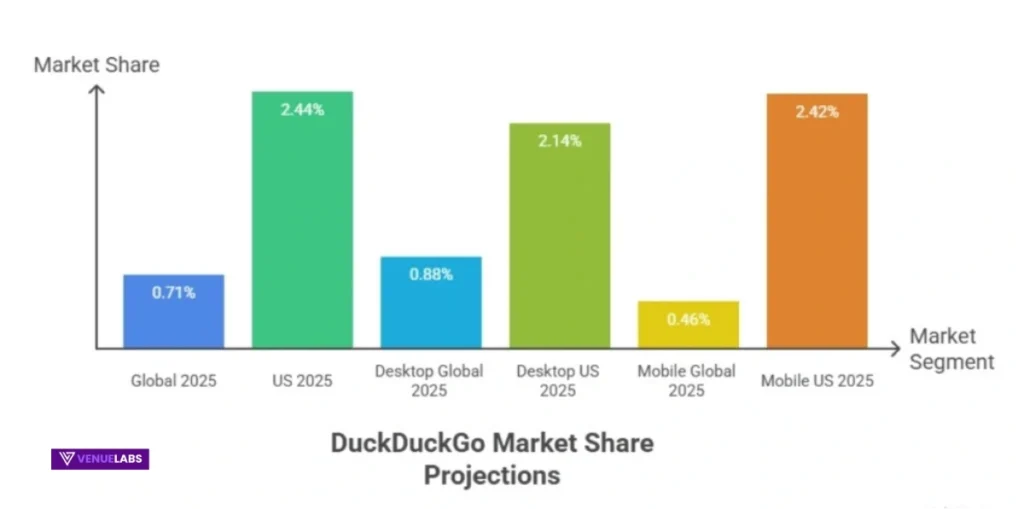
Global DuckDuckGo Desktop Market Share
On desktops, DuckDuckGo claims a 0.71% share of the worldwide search market.
This positions it as the 4th most popular search engine among desktop users, competing effectively against established names like Google, Bing, and Yahoo.
DuckDuckGo Global Desktop Market Share (Since 2012)
| Year | DuckDuckGo Market Share |
| 2012 | 0.01% |
| 2013 | 0.01% |
| 2014 | 0.05% |
| 2015 | 0.13% |
| 2016 | 0.15% |
| 2017 | 0.3% |
| 2018 | 0.38% |
| 2019 | 0.5% |
| 2020 | 0.64% |
| 2021 | 0.89% |
| 2022 | 0.94% |
| 2023 | 0.72% |
| 2024 | 0.71% |
Global DuckDuckGo Mobile Market Share
The mobile market presents a tougher challenge globally, where DuckDuckGo holds a 0.46% share of the worldwide mobile search engine market.
It ranks 6th, trailing behind Google, Yandex, Baidu, Bing, and Yahoo. However, as we will see, its performance in the US mobile market tells a different story.
DuckDuckGo Global Mobile Market Share (Since 2014)
| Year | DuckDuckGo Market Share |
| 2014 | 0.03% |
| 2015 | 0.05% |
| 2016 | 0.06% |
| 2017 | 0.08% |
| 2018 | 0.19% |
| 2019 | 0.33% |
| 2020 | 0.38% |
| 2021 | 0.47% |
| 2022 | 0.51% |
| 2023 | 0.46% |
| 2024 | 0.46% |
The US Market: A Stronghold for DuckDuckGo
The United States stands out as a particularly strong market for DuckDuckGo, showcasing its deepest penetration.
DuckDuckGo US Market Share
In the US, across all device types, DuckDuckGo proudly claims a 1.96% market share of the search engine market.
This makes it the 4th most used search engine in the country, just behind Google, Bing, and Yahoo. Notably, Yahoo, its closest competitor, is only marginally ahead with a 2.44% share.
DuckDuckGo US Market Share (Since 2012)
| Year | DuckDuckGo Market Share |
| 2012 | 0.02% |
| 2013 | 0.05% |
| 2014 | 0.12% |
| 2015 | 0.32% |
| 2016 | 0.34% |
| 2017 | 0.52% |
| 2018 | 0.69% |
| 2019 | 1.15% |
| 2020 | 1.61% |
| 2021 | 2.42% |
| 2022 | 2.41% |
| 2023 | 1.93% |
| 2024 | 1.96% |
DuckDuckGo US Desktop Market Share
Among desktop users in the US, DuckDuckGo boasts a 2.14% search engine market share. It crossed the 1% market share milestone in 2019 and has since more than doubled its presence.
DuckDuckGo US Desktop Market Share (Since 2012)
| Year | DuckDuckGo Market Share |
| 2012 | 0.02% |
| 2013 | 0.06% |
| 2014 | 0.14% |
| 2015 | 0.37% |
| 2016 | 0.39% |
| 2017 | 0.62% |
| 2018 | 0.67% |
| 2019 | 1.1% |
| 2020 | 1.63% |
| 2021 | 2.53% |
| 2022 | 2.63% |
| 2023 | 2.13% |
| 2024 | 2.14% |
DuckDuckGo US Mobile Market Share
This is where DuckDuckGo truly shines in the US. It commands an impressive 1.81% share of the US mobile search market, making it the second most popular mobile search engine in the US.
Only Google, with its near-monopolizing 95.06% market share, surpasses it. This remarkable performance on mobile in the US contrasts sharply with its global mobile market share and highlights a targeted success.
DuckDuckGo US Mobile Market Share (Since 2013)
| Year | DuckDuckGo Market Share |
| 2013 | 0.01% |
| 2014 | 0.08% |
| 2015 | 0.21% |
| 2016 | 0.22% |
| 2017 | 0.33% |
| 2018 | 0.59% |
| 2019 | 1.02% |
| 2020 | 1.52% |
| 2021 | 2.29% |
| 2022 | 2.22% |
| 2023 | 1.76% |
| 2024 | 1.81% |
Apps and Extensions: Expanding the Privacy Ecosystem
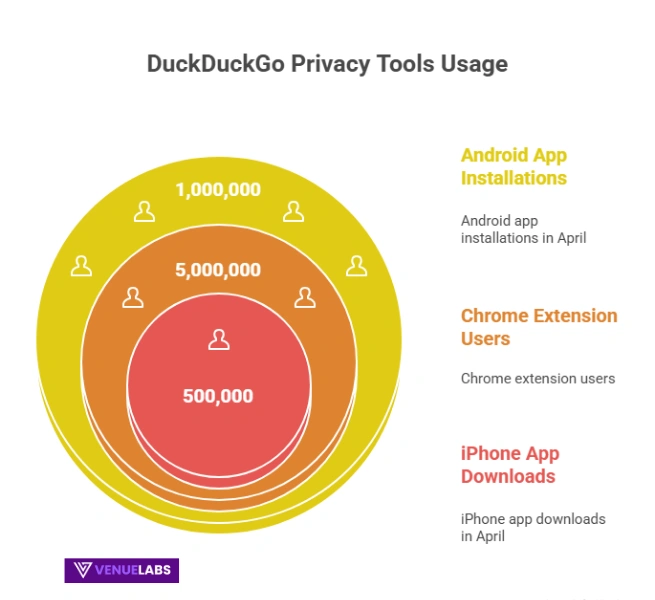
DuckDuckGo understands that privacy needs extend beyond the search bar. They offer a suite of tools, including mobile browsing apps for both iOS and Android, and a Chrome browser extension.
DuckDuckGo App Downloads
Their mobile apps are incredibly popular. In April 2024 alone, the DuckDuckGo Privacy Browser for iPhone users saw 500,000 downloads.
The Android app is even more successful, with 1,000,000 installations in April 2024, and its all-time downloads exceeding 50 million. The apps consistently receive excellent reviews, holding a cross-platform average of 4.5/5.
DuckDuckGo Chrome Extension Usage
The DuckDuckGo Privacy Essentials Chrome extension, which actively blocks hidden trackers and assesses website privacy grades, boasts over 5 million users.
This demonstrates a significant demand for proactive privacy tools directly integrated into users’ browsing experience.
Funding and Valuation: A Strong Financial Foundation
DuckDuckGo’s financial health is robust, enabling its continued development and growth.
The company has successfully raised $113 million across 3 funding rounds, including a substantial secondary investment of $100 million in late 2020.
They have the support of 29 investors, indicating strong confidence in their mission and business model.
DuckDuckGo Funding Data
| Date | Funding Amount |
| October 2011 | $3 million |
| August 2018 | $10 million |
| 2020 | $100 million |
As of its last funding round, DuckDuckGo was valued at an estimated $236-354 million. This valuation reflects its growing influence and potential in the tech industry.
DuckDuckGo Valuation (Since 2011)
| Year | Valuation |
| 2011 | $19.82 million |
| 2018 | $74.8 million |
| 2021 | $236-354 million |
Philanthropy: Giving Back to the Privacy Community
DuckDuckGo actively supports the broader internet privacy ecosystem through donations. In 2023, the company donated a total of $1,100,000 to 25 organizations dedicated to internet privacy.
Their largest donations of 125,000 each went to prominent groups like the Electronic Frontier Foundation(EFF),TheMarkup, and Public Knowledge .
DuckDuckGo Annual Donations (Since 2011)
| Year | Amount (Number of Organizations) |
| 2011 | $1,909 (6) |
| 2012 | $11,640 (7) |
| 2013 | $20,000 (7) |
| 2014 | $40,000 (6) |
| 2015 | $125,000 (5) |
| 2016 | $225,000 (9) |
| 2017 | $400,000 (16) |
| 2018 | $500,000 (21) |
| 2019 | $600,000 (11) |
| 2020 | $750,000 (15) |
| 2021 | $1,000,000 (20) |
| 2022 | $1,100,000 (24) |
| 2023 | $1,100,000 (25) |
The DuckDuckGo Team
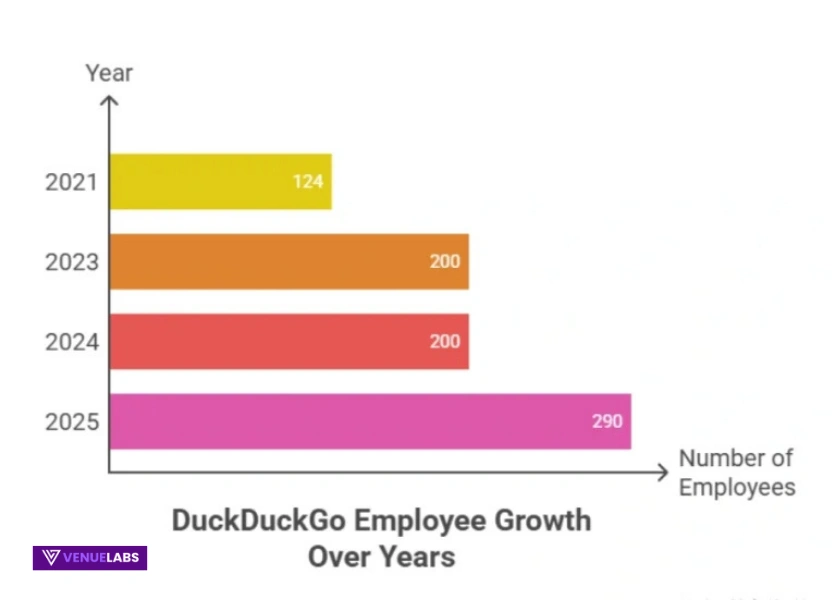
DuckDuckGo operates with a lean and effective team of 200 employees. These individuals work remotely from over 15 countries, embodying a modern, distributed workforce model.
The headcount has remained stable over the past year, indicating a well-managed and focused team.
DuckDuckGo Employee Growth (Since March 2018)
| Date | Employees |
| March 2018 | 45 |
| March 2019 | 59 |
| March 2020 | 83 |
| March 2021 | 124 |
| March 2022 | 172 |
| March 2023 | 200 |
| March 2024 | 200 |
User Demographics and Interests
While DuckDuckGo does not track its users, third-party data offers insights into its user base.
- Gender: A majority of DuckDuckGo users are male, accounting for 73.3%, compared to 26.7% female users.
- Age: The largest age group using DuckDuckGo is 25 to 34 years old (26.42%), followed by 18-24-year-olds (19.37%). Only 8.93% of users are aged 65+.
- Top Browsing Interests: Interestingly, the top browsing interest by category among DuckDuckGo users is ‘Adult,’ while by topic, it is ‘News.’ This highlights that users value privacy for all aspects of their online lives, whether for sensitive searches or staying informed without surveillance.
Geographical Usage
Almost half (49%) of DuckDuckGo’s traffic originates from the United States, making it its largest market by far. Other significant user bases come from:
- UK: 5.36%
- Germany: 5.12%
- Canada: 4.48%
- France: 2.48%
Globally, North America represents a significant stronghold, with DuckDuckGo holding a 2.11% market share, making it the fourth biggest search engine in the region.
The “Privacy Blunder” and Resilience
In early 2022, DuckDuckGo faced public backlash due to a “privacy blunder” where a security researcher discovered that its mobile browser did not block Microsoft trackers on some third-party websites, attributed to a “search syndication agreement.”
This revelation caused a temporary dip in daily search volumes, peaking in January 2022 at 106 million and falling below 100 million by April.
However, the data also shows signs of recovery, with search volumes increasing by 1.2 million in August 2022, suggesting that users continue to value DuckDuckGo’s core privacy principles and are willing to give it another chance after transparent addressing of concerns.
This incident became a critical learning experience, reinforcing the importance of absolute transparency in privacy promises.
User Demand for Privacy
The growth of DuckDuckGo is not accidental; it reflects a deep-seated desire among internet users for greater privacy.
- Stronger Privacy Laws: Almost 70% of internet users in the US advocate for stronger privacy laws, emphasizing the ability to easily opt-out of online tracking.
- National Privacy Law: Over 60% would strongly favor Congress passing a national privacy law to protect user data from corporate misuse, with an additional 18.8% somewhat favoring it.
- Risks of Data Collection: A significant 81% of people in the US believe that data collection by companies carries more risks than benefits.
- Motivation for Alternate Search Engines: Nearly 35% of surveyed people in the US expressed motivation to use an alternative search engine if an option existed that did not collect personal data from their online activities.
These statistics underscore the vital role DuckDuckGo plays in meeting a fundamental user need that traditional search engines often overlook.
How You Can Benefit from DuckDuckGo
For those looking to enhance their online experience, DuckDuckGo offers tangible benefits:
- True Privacy: Your searches are never tracked, stored, or shared. This means no personalized ads following you around the internet, and no filter bubbles shaping your search results. You see unbiased results, free from your past browsing history.
- Unbiased Search Results: Without a profile of your past searches or demographics, DuckDuckGo provides a more objective search experience. This can lead to discovering a broader range of information and perspectives.
- Built-in Tracker Blocking: The DuckDuckGo browser and extension actively block hidden trackers across the web, making your browsing experience faster and more secure. You can see a “Privacy Grade” for websites you visit, empowering you to make informed decisions.
- Smarter Search Features: DuckDuckGo includes “Bangs,” which are shortcuts that allow you to search directly on other sites. For example, typing “!w privacy” instantly searches Wikipedia for “privacy.” This saves time and streamlines your research.
- Enhanced Security: By minimizing data collection, DuckDuckGo reduces your digital footprint, making you less vulnerable to data breaches and targeted cyberattacks.
- Mobile Protection: The DuckDuckGo Privacy Browser for iOS and Android offers comprehensive privacy protection on the go, including tracker blocking and email protection.
What Users Are Asking: The Latest Buzz
Beyond the core statistics, online communities like Quora and Reddit reveal emerging user concerns and interests regarding DuckDuckGo in 2025.
- AI Integration and Privacy: Users are keenly asking how DuckDuckGo plans to integrate AI features (like AI-powered summaries or chatbots) while strictly adhering to its no-tracking policy. The debate centers on how AI can enhance search without compromising user data. DuckDuckGo has indicated it will explore AI enhancements, but only with robust privacy safeguards built-in from the ground up, likely by performing AI processing locally or using privacy-preserving models.
- Expansion of Privacy Tools: There’s a growing demand for DuckDuckGo to offer more comprehensive privacy tools beyond just search and browser extensions. Users are looking for things like a dedicated VPN service, encrypted messaging, or more advanced identity protection features directly integrated into the DuckDuckGo ecosystem, rather than relying on third-party solutions.
- Performance and Speed: Some users, particularly in regions with slower internet, are inquiring about DuckDuckGo’s performance relative to Google, especially with image and video search. While privacy is paramount, speed and efficient loading times remain critical for a seamless user experience. DuckDuckGo continuously optimizes its infrastructure to deliver competitive speeds.
- Transparency Post-Microsoft Incident: Following the “privacy blunder” involving Microsoft trackers, users on forums still occasionally ask about ongoing transparency measures and how DuckDuckGo ensures such incidents do not recur. DuckDuckGo has since updated its policies and communication to explicitly clarify such partnerships, reinforcing trust.
- Default Search Engine Status: Many conversations revolve around how DuckDuckGo can become a more easily accessible default search engine on various devices and browsers, especially in the face of dominant competitors. Users are frustrated by the effort sometimes required to switch from pre-installed defaults. DuckDuckGo actively advocates for fair “choice screen” options in operating systems and browsers.
These discussions highlight that while privacy remains DuckDuckGo’s core appeal, users in 2025 are also looking for a comprehensive, high-performing, and transparent privacy ecosystem.
FAQs About DuckDuckGo Statistics
1. Is DuckDuckGo growing in popularity in 2025?
Yes, DuckDuckGo processes around 3 billion search queries monthly, showing strong growth, particularly in the US.
2. How does DuckDuckGo make money without tracking?
DuckDuckGo earns through non-tracking ads based on keywords and affiliate marketing when users make purchases via links.
3. Can I use DuckDuckGo on mobile?
Yes, DuckDuckGo offers privacy-focused browser apps for iOS and Android, with tracker blocking and secure browsing.
4. What is DuckDuckGo's privacy grade feature?
The privacy grade shows a website’s privacy score (A-F), based on tracker blocking, helping you assess its privacy practices.
5. Is DuckDuckGo free from Microsoft trackers?
DuckDuckGo blocks most third-party trackers, including Microsoft’s, but some ads from syndicated content may still involve Microsoft.
Also Read:
- Gemini Statistics
- Videogame Industry Statistics
- Link Building Statistics
- Content Marketing Statistics
- Email Marketing Statistics
Conclusion
The DuckDuckGo statistics 2025 paint a clear picture: it remains a vital and growing force in the search engine market.
Its unwavering commitment to user privacy resonates deeply with millions worldwide, especially in the United States, where it enjoys significant market share, particularly on mobile.
Despite facing challenges and the sheer dominance of its competitors, DuckDuckGo’s steady user base, financial strength, and philanthropic efforts demonstrate its long-term viability and impact.
As digital privacy concerns continue to escalate, DuckDuckGo stands ready to serve those who prioritize anonymity and control over their online data.
It offers a powerful, user-friendly alternative that empowers you to search the internet on your terms.
