
The world of marketing is constantly evolving, and at its heart lies online advertising. In 2025, digital ads are not just a trend; they are the backbone of brand visibility, customer acquisition, and sustained business growth worldwide.
From the smallest local businesses to global enterprises, everyone is vying for attention in the vast digital landscape.
If you’re looking to understand where online advertising is heading and how to harness its power for your benefit, you’ve come to the right place.
This article provides an in-depth look at the latest online advertising statistics for 2025, offering insights into market values, consumer behavior, technological advancements, and strategic imperatives.
We’ll break down complex data into simple, actionable knowledge, helping you navigate the dynamic world of online advertising with confidence.
Get ready to discover what’s truly working, where the money is flowing, and what innovations are set to define the future of reaching your audience.
The Massive Scale of Online Advertising
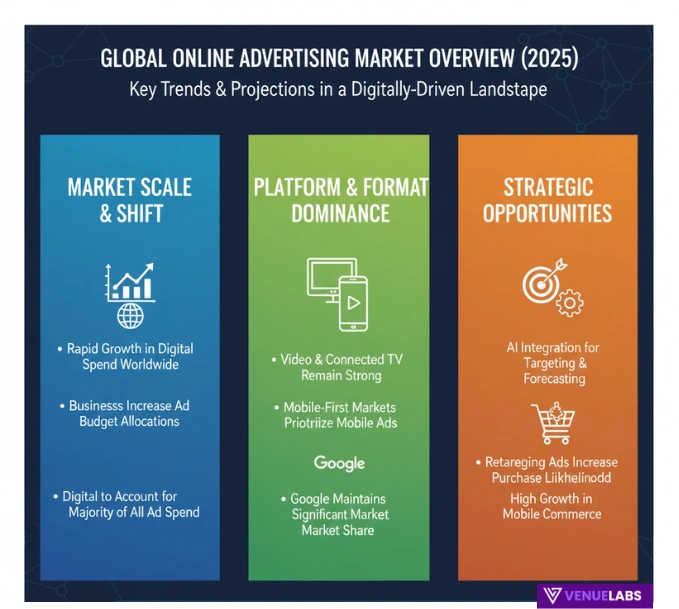
Online advertising is no longer just a segment of the broader advertising market; it’s the dominant force. In 2025, the global online advertising market boasts an impressive valuation of $294.28 billion.
This reflects its absolutely critical role in helping brands get seen and acquire new customers. Businesses are pouring substantial investments into digital channels – from engaging social media campaigns to sophisticated programmatic ad buys – because this is where their target audiences spend the majority of their time.
The sheer scale of the advertising industry as a whole is staggering. Global ad spending is projected to hit an incredible $1.16 trillion in 2025.
Digital advertising makes up a huge portion of this, and by 2029, digital channels will account for 80% of all ad spending worldwide. This trend clearly shows that the future of advertising is overwhelmingly digital.
Let’s look at some key online advertising statistics for 2025 at a glance:
| Metric | Value (2025) |
| Global Online Advertising Market Value | $294.28 billion |
| Global Ad Spending (Projected) | $1.16 trillion |
| Digital Ad Spending (Projected) | $700 billion |
| TV and Video Advertising Market Volume | $353.91 billion |
| US Ad Spending (Projected) | $455.93 billion |
| Average In-App Ad Spend Per Person (Projected) | $49.93 |
| Social Media Ad Spending (Projected) | $276.72 billion |
| Video Advertising Spending (Projected) | Over $120 billion |
| Out-of-Home (OOH) Advertising (Projected) | $40 billion |
These numbers highlight the monumental investment and rapid growth occurring within the digital advertising ecosystem.
Marketers who understand these trends are better equipped to make informed decisions and allocate their budgets effectively.
Also read about: Video Marketing Statistic
General Advertising Trends: What’s Driving the Market
Advertising as an industry is accelerating at an unprecedented pace. Here’s a broader view of the key trends and figures shaping the entire advertising landscape, with a strong emphasis on digital’s growing dominance.
Global ad spending is set to reach $1.1 trillion by the end of 2025. This massive figure underlines the importance brands place on reaching consumers through various media.
Significantly, 50% of all ad spending is now digital, showing a steady decline in traditional channels’ share. Consumers actively prefer personalized experiences, with 80% saying they like ads tailored to their interests.
This preference for personalization is a major driver of digital advertising’s success.
Influencer marketing continues its ascent, projected to be worth $24 billion by 2025. This shows the power of authentic recommendations and the shift from traditional celebrity endorsements to relatable digital personalities.
Native advertising, which blends seamlessly with surrounding content, generates 53% more engagement than standard banner ads, proving that less intrusive advertising performs better.
Email marketing remains a powerhouse, delivering an incredible average ROI of $42 for every $1 spent, making it one of the most cost-effective channels available. Finally, younger audiences are deeply influenced by social media, with 73% of Gen Z consumers discovering new brands through social media ads.
Let’s look at global ad expenditure from 2020 to 2025:
| Year | Global Ad Spend |
| 2020 | $601.84 billion |
| 2022 | $549.51 billion |
| 2023 | $601.84 billion |
| 2024 | $1.08 trillion |
| 2025 (projected) | $1.16 trillion |
Notice the significant jump in 2024 and 2025, clearly indicating a resurgence and rapid expansion after the fluctuations of earlier years.
Also read about: Latest Digital Marketing Statistics
Advertising Platforms & Categories: Where Money is Flowing
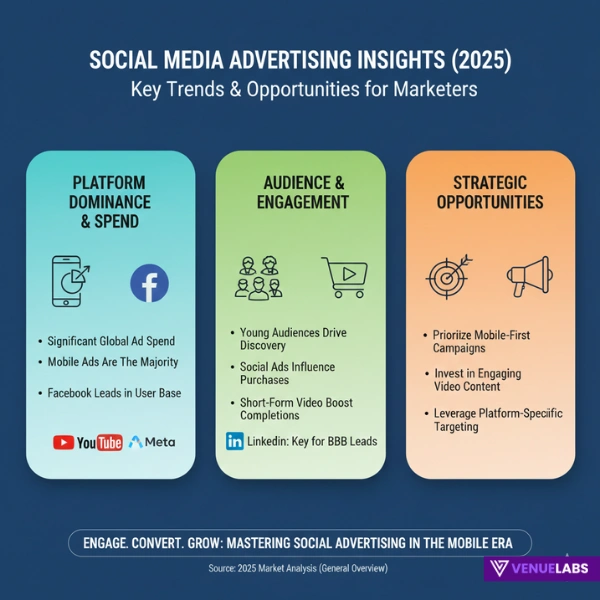
Advertisers are diversifying their budgets across various digital platforms and categories to reach consumers effectively.
Mobile Advertising: This category focuses on engaging users through in-app ads, social media ads, mobile web banners, and video ads specifically designed for smaller screens.
Mobile advertising allows brands to connect with users anytime, anywhere, leveraging advanced targeting based on location, behavior, and preferences. It’s truly proving its worth among all advertising formats.
A staggering 95.9% of global internet users access the web via mobile phones at least occasionally, and mobile devices now generate 63% of worldwide web traffic. This ubiquity makes mobile advertising indispensable.
Global in-app advertising spending is projected to hit $390.04 billion in 2025, with its market volume expected to reach $533.92 billion by 2029. The average in-app advertising spend per mobile internet user is forecasted to be $59.23 in 2025.
The US leads in mobile ad spending at $233 billion, followed by China with $163.5 billion. Clearly, mobile is not just a trend; it’s the dominant force, making up 70% of total digital ad revenue.
Here’s a look at the increasing number of mobile users globally:
| Year | Mobile Users (in billions) |
| 2020 | 6.95 |
| 2021 | 7.10 |
| 2022 | 7.26 |
| 2023 | 7.33 |
| 2024 | 7.41 |
| 2025 | 7.49 |
Social Media Advertising: These ads come in various formats, including images, videos, carousels, and sponsored content, adapting to different goals like brand awareness and conversions.
A key advantage of social media advertising is its interactive nature, encouraging likes, shares, and comments, which builds trust and loyalty.
Social media ad spending is projected to reach $276.72 billion in 2025, and its market volume will rise to $406.45 billion in 2029. By 2029, 83% of its total ad spend will come from mobile, and the number of its users is forecasted to hit 6.5 billion.
Social media ads are especially crucial for reaching younger audiences (16 to 24), serving as the leading channel for brand discovery.
The click-through rate on social networks reached 0.66% in Q2 2024, showing steady engagement. Average spending by U.S. social media buyers is forecasted to rise from $937 in 2025.
Social media ads now account for nearly 40% of total digital ad spend. Meta, the owner of Facebook and Instagram, ranks second in overall digital advertising revenue with $184 billion, a testament to its social media advertising power.
Here are the top 5 countries by total advertising spend as a percentage of GDP, highlighting how much countries prioritize advertising:
| Country | Ad Spend as % of GDP |
| U.K. | 1.66% |
| U.S.A. | 1.46% |
| Japan | 1.33% |
| China | 1.28% |
| Australia | 1.10% |
Programmatic Advertising: This is the automated buying and selling of ad space, making ad placement incredibly efficient and targeted. Programmatic advertising is set to dominate, generating 85% of total advertising revenue by 2029. It already accounts for nearly 90% of all digital display ad purchases, proving its essential role in modern digital campaigns.
Video Advertising: Video ads have the highest engagement rate, outperforming other formats by 120%. Video advertising spending is expected to surpass $120 billion globally in 2025.
Short-form video ads, particularly on platforms like TikTok, Instagram Reels, and YouTube Shorts, are driving 70% higher engagement rates than traditional video ads.
YouTube is a massive player in digital advertising revenue, with $209 billion, including $190 billion from Google itself. TV and video advertising will remain the largest segment, with an estimated market volume of $353.91 billion in 2025, showing that even with digital’s rise, video remains a powerful medium.
Search Advertising: This remains a dominant force, making up nearly 40% of digital ad budgets. Google continues its reign, expected to generate $340 billion by 2027, accounting for 40% of total global digital ad revenues. This underscores the importance of paid search in capturing user intent.
Other Notable Categories:
- Retail Media Advertising: Projected to hit $130 billion by 2026, this involves ads placed directly on e-commerce sites, allowing brands to reach consumers at the point of purchase.
- Out-of-Home (OOH) Advertising: This traditional category is rebounding, with $40 billion expected in 2025, adapting to integrate digital elements.
- Connected TV (CTV) Ad Spending: Projected to hit $45 billion by 2026, this refers to ads on streaming services and smart TVs, offering a new frontier for video advertisers.
- Podcast Advertising: Surpassing $4 billion in annual revenue, this rapidly growing segment taps into engaged audio audiences. Amazon Prime Video, for example, secured over $1.8 billion in advertising commitments during a recent upfront event, significantly outperforming rival Netflix, and analysts predict Amazon could achieve $3.5 billion to $4 billion in ad revenues by the end of 2025.
Also read about: Digital PR Statistics
Consumer Behavior & Ad Interaction: Understanding Your Audience

Understanding how consumers respond to different content, messaging, and platforms is crucial for brands to stand out.
- 70% of American retail consumers were likely to buy holiday gifts from online-only retailers, highlighting the dominance of e-commerce.
- 46% of people agreed that they purchased at least one product after listening to a podcast, showing the influence of audio content.
- 96% of consumers are likely to purchase in at least one common personalization scenario, reinforcing the demand for tailored experiences.
- 68% of marketers say personalization significantly improves ad performance, directly linking consumer preference to marketing success.
The Future of AI in Online Advertising
The future of online advertising in 2025 is becoming more immersive, intelligent, and user-centric, largely thanks to Artificial Intelligence (AI).
We can expect a greater emphasis on personalization powered by AI, with ads tailored to individual preferences, behaviors, and real-time contexts.
- With the rise of AI usage among consumers for search, B2B companies have seen a 47% increase in traffic, compared to a 45% increase for B2C companies.
- The AI market size is valued at $243.7 billion, while the global market value of AI in marketing stands at $47 billion, demonstrating AI’s significant role in the industry.
- About 30% of organizations have already implemented initial generative AI (GenAI) solutions, while another 27% are actively assessing their effectiveness, indicating rapid adoption.
- Consumer comfort with brands using AI has declined, with a 2024 survey indicating only 46% of consumers expressed comfort with brands utilizing AI, down from 57% in 2023. This suggests a need for transparent and ethical AI practices.
- Despite this dip in comfort, consumers’ faith in AI remains strong, with annual spending on AI by consumers reaching about $1.4 billion, and about 26% of them trust brands generally to use AI responsibly. This shows a nuanced relationship where trust is earned through responsible use.
- AI-driven ad spend is expected to grow by 25% year-over-year, clearly pointing to AI as a major growth engine for the advertising industry.
What Users Are Asking About Online Advertising on Quora and Reddit
Beyond the statistics, real-world questions from marketers and business owners on platforms like Quora and Reddit offer invaluable insights into current challenges and interests. Users frequently ask:
- “How do I balance personalization with privacy concerns in my online ads?” This reflects the tension between delivering relevant ads and respecting user data, especially with declining consumer comfort with AI.
- “What are the most effective ways to use short-form video ads for my specific business?” Marketers are trying to capitalize on the high engagement rates of platforms like TikTok and Instagram Reels but need guidance on industry-specific strategies.
- “How can small businesses compete with larger brands in online advertising?” This question highlights the need for efficient, targeted strategies that maximize ROI on limited budgets, emphasizing the importance of precise targeting and niche marketing.
- “What are the emerging AI tools for ad creation and optimization, and are they worth the investment?” Marketers are eager to leverage AI but need practical advice on which tools deliver tangible results and how to integrate them effectively into their workflows.
- “Is influencer marketing still worth it, and how do I find the right micro-influencers for my brand?” With the projected growth of influencer marketing, businesses are looking for genuine connections and effective ways to collaborate with influencers, particularly micro-influencers who often have more engaged audiences.
- “How do I interpret my Google Ads and Facebook Ads conversion data to make better decisions?” This points to a common challenge where marketers have access to data but struggle to translate it into actionable strategies for improving performance.
- “What are some real-world examples of eco-conscious advertising, and how can my brand genuinely adopt it?” With 65% of consumers preferring sustainable brands, marketers are looking for authentic ways to align their advertising with eco-conscious values rather than just greenwashing.
These questions reveal a market eager for practical guidance, ethical considerations, and effective strategies to navigate the complexities of online advertising in 2025.
Benefits of Mastering Online Advertising for You
For any business or individual marketer, understanding and utilizing online advertising is no longer optional; it’s essential. Here’s how you can benefit:
1. Precision Targeting: Online advertising lets you reach your ideal customer with incredible accuracy. Instead of casting a wide net, you can target based on demographics, interests, behaviors, location, and even past interactions. This means your ads are seen by people most likely to be interested in your product or service, significantly improving efficiency.
2. Measurable Results: Unlike traditional advertising, online campaigns provide detailed metrics on performance. You can track impressions, clicks, conversions, cost per click, return on ad spend (ROAS), and much more. This data empowers you to optimize your campaigns in real-time, ensuring every dollar spent works harder for you.
3. Cost-Effectiveness: Online advertising can be highly cost-effective, especially for small and medium-sized businesses. You can often start with modest budgets and scale up as you see results. The ability to set daily budgets and pause campaigns anytime gives you complete control over your spending.
4. Global Reach: Online advertising transcends geographical boundaries. With a few clicks, your ads can be seen by potential customers across continents, opening up new markets and growth opportunities that would be impossible with traditional methods.
5. Flexibility and Adaptability: The digital landscape changes rapidly, and online advertising allows you to be agile. You can quickly create new ad variations, test different messages, adjust targeting, and adapt your strategies based on real-time performance data and emerging trends.
6. Brand Building and Awareness: Beyond direct sales, online advertising is a powerful tool for building brand recognition and establishing authority in your niche. Consistent online presence and engaging ad content can significantly increase your brand’s visibility and recall.
7. Deep Consumer Insights: The data generated from your online advertising campaigns offers invaluable insights into your target audience. You learn what resonates with them, what they click on, and what motivates them to convert. This knowledge extends beyond advertising, informing your product development, content creation, and overall business strategy.
Also Read:
- Artificial Intelligence Statistics
- Gemini Statistics
- Live Streaming Statistics
- Content Marketing Statistics
- Podcast Statistics
Conclusion
The landscape of online advertising in 2025 is rapidly evolving, driven by shifting consumer expectations, cutting-edge technologies like AI, and dynamic platform dynamics.
The statistics shared throughout this article highlight the paramount importance of personalization, omnichannel strategies, and authentic, engaging content in capturing audience attention and driving conversions.
As competition intensifies, brands that proactively leverage data-driven insights and adapt to changing consumer behavior trends will undoubtedly be better positioned to stand out and achieve success in 2025 and beyond.
Staying informed, remaining agile, and continuously innovating are not merely advantages—they are absolute necessities for marketers aiming to thrive in this thrilling digital age. The future of advertising is here, and it’s more exciting and effective than ever before.
Source: Statista, Sender.net
