
Remote work has undeniably transformed the global employment landscape.
What began as a crisis-driven necessity has blossomed into a preferred, strategic model for businesses and a highly coveted benefit for employees.
As we push deeper into 2026, the insights from the latest data reveal a dynamic and evolving future for how and where we work.
This comprehensive guide, packed with “Remote Work Statistics 2026,” will help you understand this shift and leverage it to your advantage.
The Current Pulse of Remote Work: Statistics for 2026
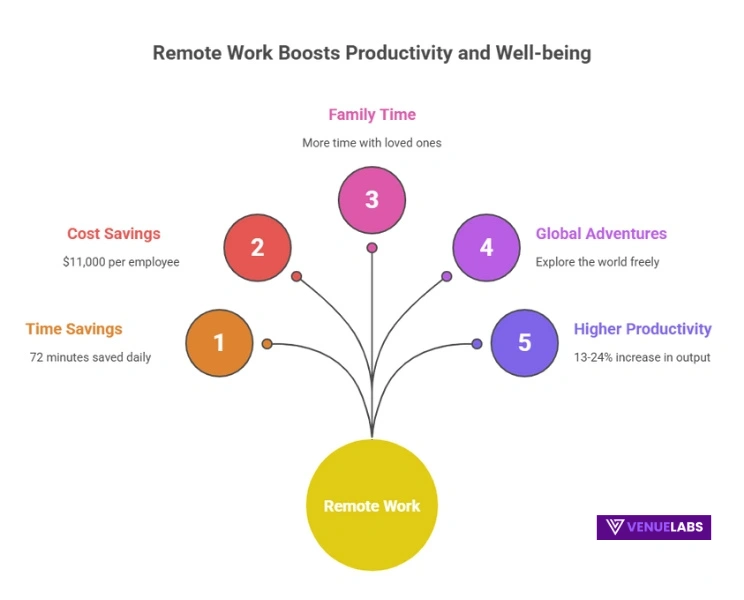
The journey from traditional office setups to flexible work environments has been swift and profound.
Today, nearly one in five full-time employees are working remotely, with a significant majority of U.S. workers having access to hybrid arrangements.
These aren’t just temporary fixes; they represent a fundamental restructuring of work itself.
Key Remote Work Statistics for 2026:
- Global Adoption: 28% of the global workforce currently works remotely.
- U.S. Remote Workforce: A staggering 22 million Americans are working remotely.
- Company Structures: 16% of companies globally are fully remote, while 63% embrace hybrid work options.
- Employee Preference: An overwhelming 98% of employees want remote work, at least part-time.
- Productivity Insights: While some studies indicate an 8% to 19% decline in remote worker productivity, others show an increase of 13% to 24%, highlighting the nuanced nature of this factor.
- Talent Attraction: 59% of workers are more likely to choose an employer that offers remote work.
- Employer Savings: Companies can save up to $11,000 per employee annually by switching to remote work.
Also read about: 14+ Best Work From Home Jobs In Germany
How Many People Are Truly Working from Home?
The number of individuals embracing remote work has steadily climbed since the initial lockdowns. This isn’t a passing fad; it’s a deeply embedded preference and a strategic advantage for businesses.
Global and National Figures:
- Worldwide Remote Workers: Approximately 19.5% of people globally work remotely, reflecting a continuous rise in flexible job arrangements.
- Fully Remote Companies: 16% of businesses operate with a fully remote model, while an additional 63% offer hybrid or remote-first choices. Interestingly, 44% of companies still do not permit any form of remote work.
- American Remote Workforce: 22 million Americans are projected to work remotely, a significant jump of 16.8 million from pre-pandemic figures.
Remote Work by the Numbers: Demographics and Preferences
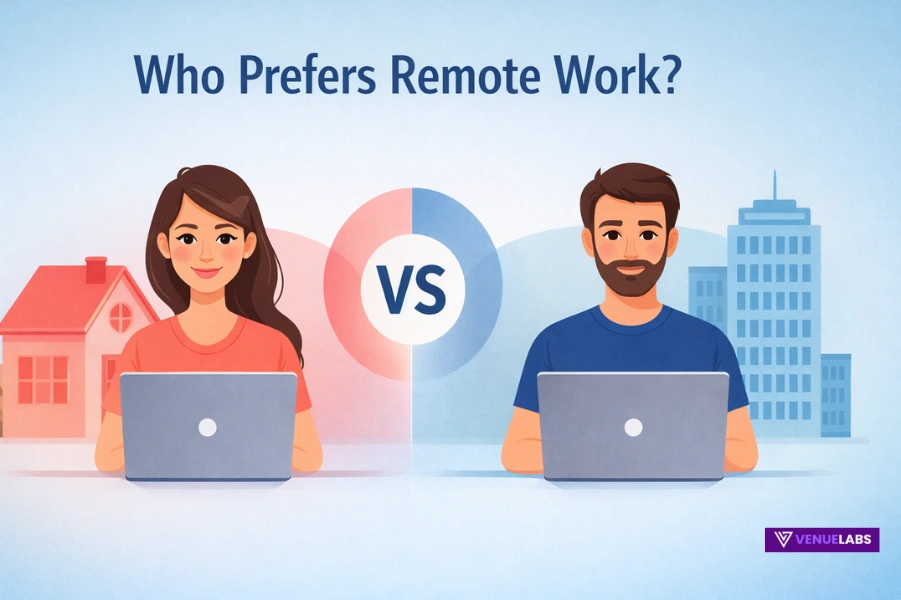
Remote work isn’t universally embraced by all demographics in the same way. Understanding these preferences is crucial for tailoring effective remote work strategies.
Who Prefers Remote Work?
- Gender:
- 61% of men and 52% of women are offered remote working opportunities.
- Women show a higher preference for remote work (46%) compared to men (39%).
- Only 1 in 10 women prefer exclusively in-office work
| Mode of Work | Women | Men |
| Remote work | 46% | 39% |
| Hybrid work | 34% | 37% |
| In-office work | 19% | 24% |
Age Groups:
- 39% of workers aged 24 to 35 (Millennials) work remotely, with an additional 25% in this group working remotely part-time. This generation highly values flexibility.
- Employees aged 18 to 25 (Gen Z) show the least interest in remote work, often preferring in-person collaboration.
| Age Group | Share of Employees That Prefer To Work From Home |
| 18 to 25 years | 27% |
| 26 to 41 years | 41% |
| 42 to 57 years | 40% |
| 58 to 76 years | 38% |
- Education Level:
- 45% of workers with advanced degrees prefer to work from home, indicating a correlation between higher education and remote work options.
- Those with only a high school education or some college are least likely to work remotely.
| Education Level | Share of Full-Time Remote Worker | Share of Part-Time Remote Worker |
| Less than high school | 32% | 21% |
| High school/some college | 29% | 19% |
| Associate’s | 31% | 19% |
| Bachelor’s | 40% | 26% |
| Advanced degree | 45% | 31% |
Also read about: 15+ Best Work From Home Jobs In Australia
Industries and Occupations Embracing Remote Work
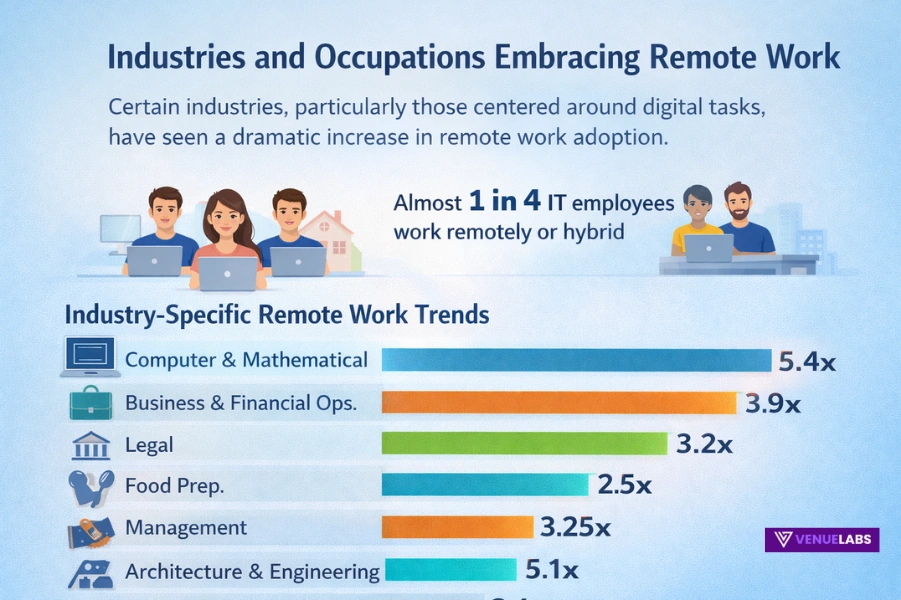
Certain industries, particularly those centered around digital tasks, have seen a dramatic increase in remote work adoption.
Industry-Specific Remote Work Trends:
- Tech and Information: Almost 1 in 4 employees in the IT industry work remotely or in a hybrid setting.
- Significant Increases Since 2019:
- Computer and Mathematical occupations saw a 5.4-fold increase in remote work.
- Business and Financial Operations increased by 3.9 times.
- Legal professions saw a 3.2-fold increase.
- Even the food preparation industry witnessed a 2.5-fold increase, showing the widespread impact.
| Industry | Increase In Remote Work Compared To 2019 |
| Computer and Mathematical | 5.4 times |
| Business and Financial Operations | 3.9 times |
| Legal | 3.2 times |
| Management | 3.25 times |
| Architecture and Engineering | 5.1 times |
| Life physical and social science | 3 times |
| Arts, Design and Entertainment | 3.4 times |
- Remote Job Listings on LinkedIn (Highest Percentage):
- Technology, Information, and Media: 41.2%
- Education: 29.0%
- Administrative and Support Services: 27.4%
- Professional Services: 26.5%
- Financial Services: 20.2%
Also read about: 15 Best Work From Home Jobs In Egypt
The Productivity Puzzle: Do Remote Workers Get More Done?
The question of remote worker productivity is complex, with studies offering varying conclusions. It often depends on the individual, the role, and the environment.
Productivity Statistics:
- Some studies indicate a decline of 8% to 19% in remote worker productivity, with others citing a 4% individual productivity drop.
- Conversely, some research suggests that remote worker productivity can increase by 13% to 24% in suitable environments.
The Allure of Flexibility: Remote Work Preferences

Employees overwhelmingly desire the flexibility that remote work offers, making it a powerful tool for attraction and retention.
Employee Preferences and Satisfaction:
- Employer Choice: 59% of workers are more likely to choose an employer that allows remote work.
- Retention: 74% of workers say remote work opportunities make them less likely to leave a company.
- Recommendation: 98% of employees would recommend remote work to others, up from 97% in 2022.
- Overall Experience: 68% of employees report a very positive experience with remote work, citing flexibility as the top benefit.
- 23% had a somewhat positive experience.
- 8% felt neutral.
- Only 1% had a somewhat negative experience, and 0% reported a very negative experience.
- Interview Process: 93% of employers plan to continue conducting job interviews remotely, signaling a sustained shift in recruitment practices.
Financial Benefits: Earnings and Savings
Remote work isn’t just about flexibility; it can also have significant financial implications for both employees and employers.
Economic Impact:
- Higher Earnings for Remote Workers: Remote workers earn almost $8,600 more on average than their in-office counterparts (9.7% higher annual pay).
- Office managers working remotely earn 31.7% more.
- Public relations managers see a 30.1% increase.
- Customer service managers and data analysts also experience higher remote earnings.
- Employer Savings: Businesses can save up to $11,000 per employee annually by adopting remote work, primarily due to reduced office space costs, lower absenteeism, and increased productivity.
Beyond the Office Walls: The Benefits Remote Workers Experience
The advantages of remote work extend far beyond avoiding a commute, touching on aspects of personal well-being and lifestyle.
Health and Lifestyle Benefits:
- Time Flexibility: 22% of employees cite flexibility in how they spend their time as the biggest benefit.
- Location Flexibility: 19% value the flexibility to live where they choose.
- Reduced Commute: 12% appreciate having more time due to eliminating commutes.
- Financial Advantage: 11% find remote work financially beneficial.
- Mental Health Improvements:
- 33% of employees report reduced anxiety and depression.
- 36% feel less burned out.
- Overall, an average of one-third of remote employees report improved physical and mental health.
| Health Benefits of Working From Home | Percentage of Employees That Experienced Betterment In Health |
| Less burnout | 36% |
| Healthier food choices | 35% |
| Reduced anxiety and depression | 34% |
| Improved overall mental health | 33% |
| Improved sleep | 32% |
| Increased exercise | 30% |
| Improved overall physical health | 28% |
The Flip Side: Challenges of Remote Work
Despite the numerous benefits, remote work comes with its own set of challenges that both employees and employers must address.
Common Remote Work Challenges:
- Burnout: 69% of remote employees experience burnout, stemming from difficulties in managing work-life boundaries and avoiding overwork.
- Lack of Connection: 53% of remote workers find it harder to connect with coworkers, highlighting the need for intentional team-building strategies.
- Distractions: 47% of employees struggle with at-home distractions.
- Isolation: 35% of remote workers report feeling isolated or lonely.
| Challenges Faced By Employees Working Remotely | Percentage of Employees That Face The Challenge |
| Managing at-home distractions | 47% |
| Collaborating with colleagues/clients | 35% |
| Isolation/loneliness | 35% |
| Motivation | 29% |
| Tasking adequate time away from work | 28% |
| Disconnecting from work/burnout | 28% |
| Networking/fostering career development | 24% |
| Other | 1% |
| None of the above | 6% |
Remote Work Trends and the Future: What to Expect by 2030
The trajectory of remote work points towards its continued growth and evolution, with hybrid models and technological advancements leading the way.
Future Outlook:
- Commuting Time Savings: Remote work helps employees save 72 minutes of daily commuting time.
- Growth Post-2021: Remote work increased by 24%, and hybrid work by 16% after 2021.
- U.S. Workforce by 2024: 60% of the U.S. workforce will be working remotely, a 20% increase from 2020.
- Hybrid Work Dominance: The hybrid work model is predicted to be the dominant approach to work location by 2030, combining the benefits of both remote and in-person collaboration.
- Increased Demand: The demand for remote work is expected to increase by 30% by 2030, driven largely by Gen Z entering the workforce with a preference for flexibility.
Top 10 Remote Work Trends for 2026: A Deeper Dive
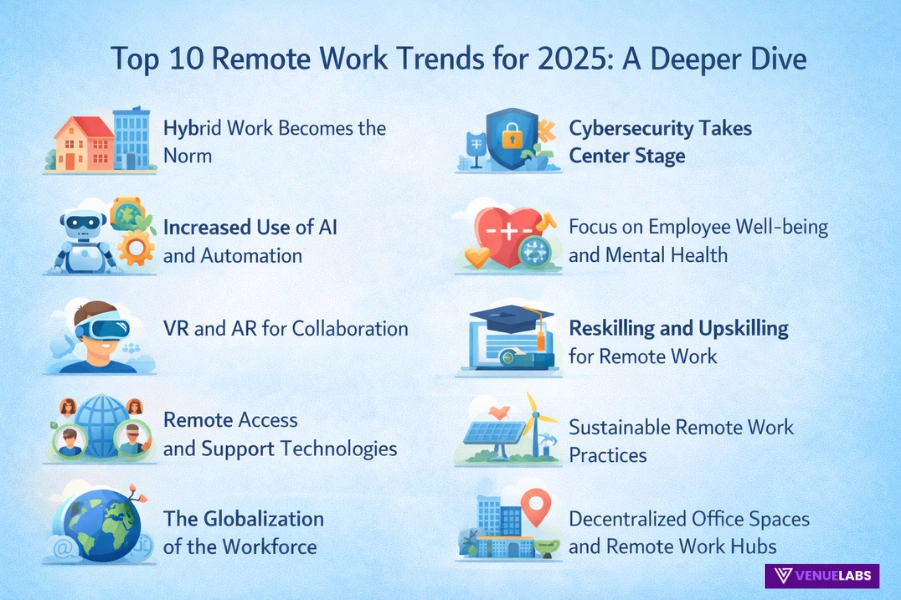
Let’s explore the critical trends shaping the remote work landscape in 2026.
Trend 1: Hybrid Work Becomes the Norm
Hybrid models offer the best of both worlds: the flexibility of remote work and the benefits of in-person collaboration.
This approach enhances employee satisfaction and retention while maintaining productivity.
Employees enjoy reduced commutes and autonomy, and organizations retain a physical space for strategic meetings and team-building.
Trend 2: Increased Use of AI and Automation
AI and automation are streamlining remote workflows, boosting productivity, and improving collaboration.
AI tools assist with scheduling, project management, and data analysis, freeing teams for higher-value tasks.
AI-powered collaboration tools like real-time transcription and intelligent scheduling reduce friction, while automation aids in IT management by monitoring system performance and implementing updates.
Trend 3: Virtual Reality (VR) and Augmented Reality (AR) for Collaboration
VR and AR are revolutionizing how remote teams connect. By 2026, immersive virtual meeting rooms and AR tools will create lifelike experiences, bridging the gap between remote and in-person interactions.
These technologies are especially valuable for industries requiring hands-on training, detailed visualizations, or interactive problem-solving, making global collaboration more effective.
Trend 4: Remote Access and Support Technologies Transforming Workplaces
Robust remote access and support solutions are critical for maintaining productivity and resolving IT issues efficiently.
Modern solutions offer multi-device compatibility, enhanced security, and real-time monitoring.
Remote support tools allow IT teams to diagnose and fix problems remotely, reducing downtime and strengthening cybersecurity with encrypted connections and proactive threat detection.
Trend 5: The Globalization of the Workforce
Remote work has removed geographical barriers, allowing companies to tap into a diverse, global talent pool.
This trend enhances innovation, provides cost-saving opportunities, and enables round-the-clock operations across multiple time zones.
However, businesses must navigate international labor laws and manage cross-cultural teams effectively.
Trend 6: Cybersecurity Takes Center Stage
With the rise of remote work comes increased cybersecurity risks. By 2026, businesses will prioritize stronger security measures like endpoint protection, multi-factor authentication, and zero-trust frameworks.
Employee training on best practices is crucial, and advanced remote access solutions offer encrypted connections and proactive monitoring to protect sensitive data.
Trend 7: Focus on Employee Well-being and Mental Health
Organizations are increasingly recognizing the importance of employee well-being and mental health in remote settings.
Companies are implementing wellness initiatives such as flexible schedules, mental health resources, and virtual check-ins to combat stress and burnout.
A holistic approach, including tools for breaks and ergonomic setups, improves satisfaction and retention.
Trend 8: Reskilling and Upskilling for Remote Work
The fast pace of technological change necessitates continuous learning.
Businesses are investing in reskilling and upskilling programs to ensure employees are proficient in new tools and processes, focusing on technical skills (e.g., collaboration tools) and soft skills (e.g., virtual communication).
This prepares the workforce for future challenges and fosters a culture of innovation.
Trend 9: Sustainable Remote Work Practices
Remote work offers significant environmental benefits by reducing commutes and carbon emissions.
Companies are promoting energy-efficient home offices, digital solutions to minimize paper, and even subsidizing renewable energy use.
These eco-friendly practices appeal to environmentally conscious employees and enhance brand reputation.
Trend 10: Decentralized Office Spaces and Remote Work Hubs
The traditional centralized headquarters is giving way to decentralized office spaces and remote work hubs.
These smaller, strategically located offices or shared workspaces provide alternatives for employees who prefer not to work exclusively from home, facilitating occasional in-person collaboration and fostering community.
This model reduces real estate costs and supports employees in various regions.
How Businesses Can Prepare for Remote Work in 2026
To thrive in this evolving landscape, businesses must proactively adapt.
Key Strategies for Businesses:
- Invest in Advanced Remote Tools: Equip teams with secure remote access solutions, collaboration tools, and AI-powered resources to boost productivity and connectivity.
- Establish Clear Objectives and Communication Channels: Define goals, ensure transparent workflows, and utilize accessible communication tools for cohesive, dispersed teams.
- Enhance Security Practices: Implement robust cybersecurity measures like multi-factor authentication, endpoint protection, and secure remote support to safeguard data.
- Prioritize Reskilling and Upskilling: Invest in continuous learning programs to equip employees with both technical and soft skills needed for virtual environments.
- Focus on Employee Wellness: Foster a healthy work-life balance through flexible schedules, mental health resources, and supportive cultural initiatives.
- Adapt to Hybrid and Decentralized Work Models: Embrace flexible arrangements, including remote work hubs, to provide choices and foster collaboration.
Quora and Reddit Insights: What Users Are Asking
Beyond the statistics, real-world questions from platforms like Quora and Reddit reveal deeper concerns and curiosities about remote work.
- “How do I prevent burnout when working remotely?” Users are actively seeking strategies for setting boundaries, managing workloads, and maintaining work-life balance. This aligns with the statistic showing 69% of remote employees experiencing burnout.
- “What are the best tools for remote team collaboration?” The demand for effective communication and project management tools is high, echoing the trend of increased AI and automation in remote work.
- “How can I maintain a social connection with my coworkers when fully remote?” This question directly addresses the challenge of isolation, with 53% of remote workers finding it harder to connect. Users want solutions for virtual team building and fostering camaraderie.
- “Is it possible to switch careers to a fully remote role without experience?” Many are exploring new career paths that offer remote flexibility, indicating a broader shift in career aspirations.
- “What are companies doing to support mental health for remote employees?” There’s a clear desire for employers to actively address mental well-being, reinforcing the growing focus on employee wellness in 2026.
These questions underscore the human element behind the statistics, demonstrating a proactive search for solutions to common remote work challenges.
FAQs About Remote Work Statistics
What are the main benefits of remote work for employees ?
Remote work offers more flexibility, no commuting, better work-life balance, higher earning potential, and improved mental and physical health.
How is remote work impacting company productivity and savings?
Productivity varies by role, but companies save up to $11,000 per employee each year through lower office and operating costs.
What are the biggest challenges of remote work?
Key challenges include burnout, weaker team connections, home distractions, and feelings of isolation.
How will AI and VR shape remote work in the future?
AI will automate tasks and improve collaboration, while VR and AR will enable immersive meetings and hands-on remote training.
Who prefers remote work the most and least ?
Employees with advanced degrees prefer remote work the most, while Gen Z shows the lowest preference, favoring in-person or hybrid work.
Also Read:
- Blogging Statistics
- Virtual Reality Statistics
- Lead Generation Statistics
- Screen Time Statistics
- Digital PR Statistics
Conclusion
Remote work is not merely a trend; it is a fundamental shift that is redefining the global workplace.
As we move through 2026, the demand for flexibility, the integration of advanced technologies like AI and VR, and a stronger focus on employee well-being will continue to shape how we work.
Businesses that proactively adapt to these “Remote Work Statistics 2026” and embrace evolving strategies will be best positioned to attract top talent, boost productivity, and foster a thriving, resilient workforce for the future.
