
Tesla isn’t just a car company; it’s a global leader in electric vehicles (EVs) and renewable energy.
The company has revolutionized transportation and energy solutions, from its high-performance electric cars to its cutting-edge battery and charging technologies.
This guide will walk you through Tesla’s incredible journey, its present status, and what lies ahead in 2025.
We’ll cover key statistics, market share, growth trends, and what makes Tesla stand out in a rapidly evolving world.
Tesla’s Evolution: A Journey of Innovation
Tesla was founded in 2003 by Martin Eberhard and Marc Tarpenning. Elon Musk joined the company soon after as an investor and became CEO in 2008.
Tesla’s first big breakthrough was launching its first electric car, the Roadster, in 2008. This car showed that EVs could offer high performance and style, setting the stage for what was to come.
Over the years, Tesla has introduced several groundbreaking vehicles, each pushing the limits of what an electric car can do:
- Model S (2012): A luxury electric sedan that redefined the segment.
- Model X (2015): Tesla’s first SUV, offering utility with advanced features.
- Model 3 (2017): The affordable electric car that became the world’s best-selling EV.
- Model Y (2020): A crossover that further expanded Tesla’s reach.
- Cybertruck (2023): A futuristic pickup truck challenging traditional designs.
- Tesla Semi (TBA): A game-changing electric truck aimed at the commercial sector.
Beyond vehicles, Tesla is leading the way in renewable energy with products like solar panels and Powerwall energy storage systems, further solidifying its position as a pioneer in sustainable living.
Tesla Statistics 2026: Key Numbers and Growth
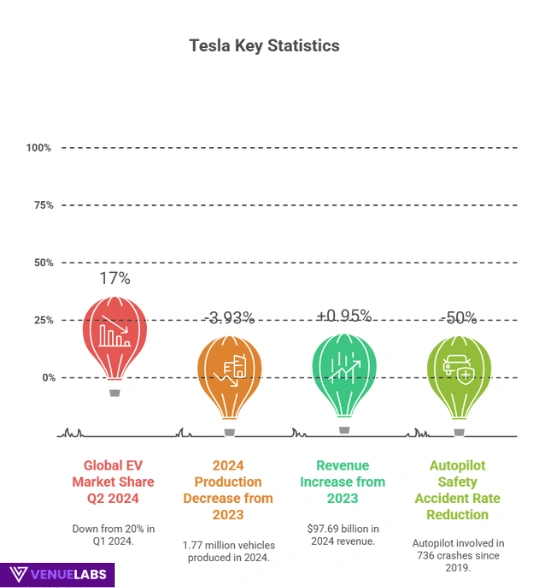
Tesla has grown rapidly over the years, showing impressive performance in its various segments. Here are some key Tesla statistics for 2025:
- Vehicle Production: Tesla is projected to produce about 2.07 million vehicles in 2025.
- Total Sales (2024): Tesla sold over 1.78 million vehicles in 2024.
- Cumulative Sales (Q1 2025): Tesla has sold more than 7.58 million vehicles by the first quarter of 2025.
- Total Revenue (2024): Tesla’s total revenue for 2024 reached $97.7 billion.
- Market Value (2024): Tesla’s market value stands at $809.93 billion.
- Global EV Market Share (Q2 2024): Tesla holds a 17% share of the global EV market.
- Supercharger Network (November 2024): Tesla has over 60,000 Superchargers across 6,856 stations worldwide.
- Employee Count (2023): Tesla employs over 140,473 individuals globally.
These statistics highlight Tesla’s consistent growth and its global impact in the EV and renewable energy sectors.
Tesla’s Manufacturing Footprint
Tesla’s manufacturing facilities are spread across multiple continents, allowing the company to cater to regional demand while expanding its production capacity. Here’s a breakdown of Tesla’s major manufacturing locations:
North America:
- Fremont, CA Factory (US)
- Gigafactory Nevada (US)
- Gigafactory New York (US)
- Gigafactory Texas (US) – produces the Cybertruck
Asia:
- Gigafactory Shanghai (China) – primarily serves the Chinese market
Europe:
- Gigafactory Berlin – Brandenburg (Germany)
Tesla also has plans to open a Gigafactory in Monterrey, Mexico, by 2026 to further expand production capacity.
Tesla’s Vehicle Production and Growth

Tesla has ramped up production significantly, showing strong growth year after year. In Q1 2025, Tesla produced 362,615 vehicles. This includes a mix of Model 3 and Model Y vehicles, as well as smaller numbers of Model S, Model X, Cybertruck, and Semi vehicles.
- 2024 Production: Tesla produced 1.77 million vehicles in 2024.
- 2025 Estimate: Tesla expects to produce 2.07 million vehicles in 2025.
Here’s a quick look at Tesla’s production figures over the past few years:
| Year | Production | Year-over-Year Growth |
|---|---|---|
| 2018 | 254,530 | – |
| 2019 | 365,232 | 43% |
| 2020 | 509,737 | 40% |
| 2021 | 930,422 | 83% |
| 2022 | 1,369,611 | 47% |
| 2023 | 1,845,985 | 35% |
| 2024 | 1,773,443 | -4% |
Tesla has delivered over 7 million vehicles in the past seven years, proving its capacity for growth.
Tesla’s Sales Performance
Tesla’s sales continue to be strong, driven primarily by its Model 3 and Model Y vehicles. In 2024, Tesla sold 1.79 million vehicles globally, with the Model 3 and Model Y accounting for 95% of those sales.
| Year | Sales | Model Breakdown |
|---|---|---|
| 2023 | 1,808,581 | Model 3/Y, Model X/S |
| 2024 | 1,789,226 | Model 3/Y, Model X/S, Cybertruck, Semi |
Tesla’s Model 3 has been the world’s best-selling EV for several years, and the Model Y continues to drive growth.
Tesla’s Financial Performance
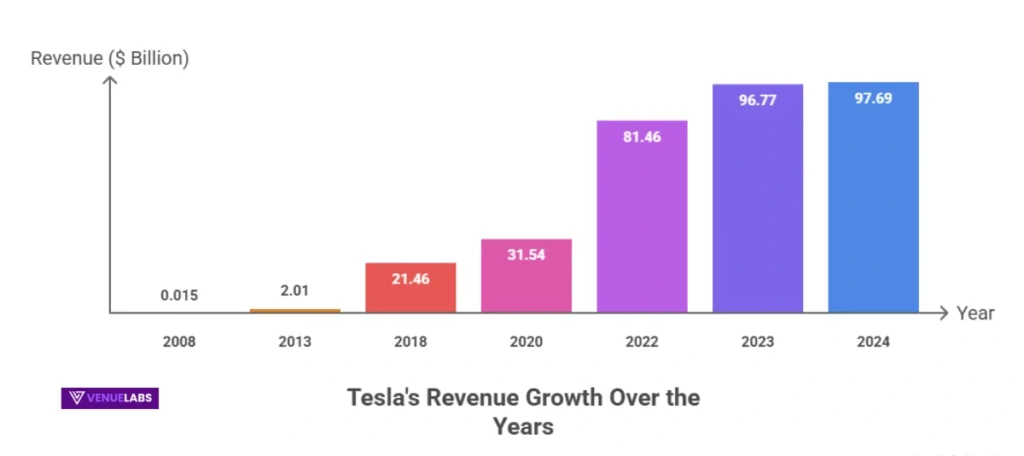
Tesla’s financial performance is a testament to its growth. In 2024, Tesla generated $97.7 billion in revenue, a modest increase of 1% from the previous year.
- Net Income (2023): Tesla’s net income reached $14.99 billion, continuing its impressive profit growth.
- Annual Revenue (2018–2024):
| Year | Revenue (USD) |
|---|---|
| 2018 | $21.46 billion |
| 2019 | $24.58 billion |
| 2020 | $31.54 billion |
| 2021 | $53.82 billion |
| 2022 | $81.46 billion |
| 2023 | $96.77 billion |
| 2024 | $97.7 billion |
Tesla’s Market Capitalization and Share
Tesla’s market value has fluctuated over the years, but it remains one of the most valuable companies globally.
- Market Capitalization (2024): $809.93 billion.
- Market Share (Global EV Market): As of Q2 2024, Tesla holds a 17% share of the global EV market.
Tesla’s U.S. market share of EVs has decreased from 65% in 2022 to 50% in 2023, showing increased competition.
Tesla’s Supercharger Network
Tesla’s extensive charging network remains one of its biggest advantages. As of November 2024, Tesla operates over 60,000 Superchargers at 6,856 stations worldwide.
This network enables Tesla owners to charge their cars quickly, often adding up to 200 miles in just 15 minutes.
Here’s a breakdown of Tesla’s Supercharger locations by region:
- United States: 17,000 chargers
- China: 2,151 chargers
- Canada: 1,490 chargers
- Europe: 1,329 chargers
Tesla continues to expand its charging network, helping to make long-distance travel easier for Tesla owners.
Autopilot and Safety
Tesla’s Autopilot feature, a key selling point, uses advanced driver-assistance systems to enhance vehicle safety.
Despite some concerns and crashes, data shows that Tesla cars with Autopilot engaged are safer than those without it.
Tesla reports one crash per 4.85 million miles driven with Autopilot, compared to one crash per 1.40 million miles without.
Tesla’s Workforce and Revenue Sources
Tesla’s workforce has grown significantly over the years. As of 2023, the company employs 140,473 people, reflecting its expanding operations.
Tesla also generates revenue from beyond vehicle sales, including:
- Automotive Sales: $44.13 billion (84% of revenue)
- Services and Other: $3.80 billion (7% of revenue)
- Energy Generation: $2.79 billion (5% of revenue)
FAQs About Tesla Statistics
1. What is the estimated total production for Tesla in 2025?
Tesla estimates it will produce approximately 2.07 million vehicles in 2025, demonstrating its ambitious plans for continued growth and market expansion.
2. How much revenue did Tesla generate in 2024?
In 2024, Tesla generated a total revenue of $97.7 billion, reflecting its strong financial performance and continued success in the electric vehicle and energy sectors.
3. What is Tesla's current market share in the global electric vehicle market?
As of Q2 2024, Tesla holds a 17% share of the global electric vehicle market, maintaining a significant presence despite increasing competition from other manufacturers.
Also Read:
- Artificial Intelligence Statistics
- Gemini Statistics
- Shopify Statistics
- Metaverse Statistics
- Live Streaming Statistics
Conclusion
Looking ahead to 2026, Tesla plans to continue its growth by producing more affordable models, cutting costs, and focusing on innovation.
The company is also working on launching Robotaxis (self-driving electric taxis) in 2026, further expanding its reach.
Tesla remains a dominant force in the electric vehicle market, and its strategy of diversifying into renewable energy positions it for even greater success in the future.
Source: Statista, Investing.com
