
Meetings are an undeniable part of our professional lives, but their effectiveness is a constant point of discussion.
In 2025, as technology continues to advance rapidly and work models evolve, understanding the latest meeting statistics is more crucial than ever.
This comprehensive article dives deep into the current landscape, revealing eye-opening trends and offering actionable insights for professionals looking to optimize their meeting experiences for maximum benefit.
The Meeting Boom: Are We Meeting Too Much?
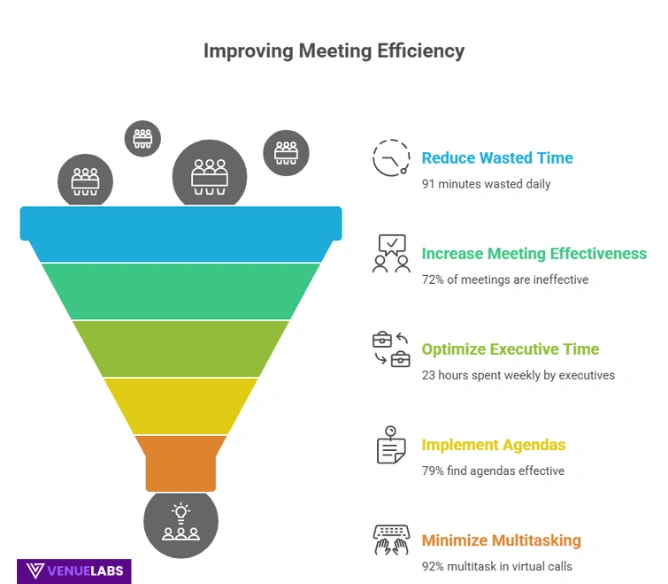
Let’s face it, we are in a meeting-intensive era. The sheer volume of daily meetings is staggering.
- Daily Deluge: The United States alone hosts approximately 11 million meetings every day, totaling over a billion annually.
- Workweek Absorption: A significant majority, 83.13% of employees, dedicate up to one-third of their entire workweek to meetings. For some, this can mean spending 20 hours or more in scheduled discussions.
- Organizational Overhead: On average, organizations allocate about 15% of their total time to meetings.
The shift to remote work during the pandemic significantly amplified this trend.
Virtual one-on-one meetings skyrocketed by 1,230% from January to December 2020, and virtual group meetings increased by over 613%.
This indicates a sustained reliance on digital communication, even as in-person interactions make a comeback.
Table 1: Employee Time Spent in Meetings Weekly
| Time Spent in Meetings | Percentage of Employees |
| Less than 4 hours | 46.15% |
| 4-12 hours | 36.98% |
| 12-20 hours | 12.14% |
| 20 hours or more | 4.73% |
This data clearly shows that a substantial portion of the workforce is spending a significant amount of their professional time in meetings.
Also read about: GoToMeeting vs WebEx 2026: Which One Is Worth It?
The Cost of Inefficiency: A Staggering Price Tag
While meetings are essential for collaboration and decision-making, poorly run meetings come with a hefty price tag.
- Billions Down the Drain: An estimated $37 billion is lost annually in the United States due to unproductive meetings. Some large businesses can individually lose up to $300 million each year.
- Time Squandered: Organizations collectively lose 24 billion hours each year to inefficient meetings.
- Professional Frustration: A shocking 71% of managers and employees view meetings as a waste of time, with 65% stating that meetings prevent them from completing their core work.
These statistics paint a stark picture: inefficiency in meetings is a significant drain on resources and employee morale.
Unpacking Unproductive Meetings: The Root Causes
Why are so many meetings failing to deliver value? Several key factors contribute to this widespread problem.
- Lack of Clear Objectives: A staggering 61% of C-suite executives believe that a lack of clear objectives is the primary culprit behind unproductive meetings.
- Missing Agendas: Only 37% of workplace meetings use an agenda, despite 67% of professionals recognizing its importance for effective meetings. Agendas can reduce meeting time by up to 80%.
- Irrelevant Content: More than half (51%) of professionals attribute meeting unproductivity to discussions that are irrelevant to them.
- Scheduling Overload: 78% of professionals identify scheduling overload as a major factor, with early-career professionals feeling this burden most acutely.
- No Feedback Loop: Only 3.7% of companies consistently collect meeting feedback, preventing organizations from learning and improving their meeting practices.
Table 2: Factors Contributing to Unproductive Meetings
| Factor | Percentage of Professionals (or relevant group) |
| Lack of clear objectives | 61% of C-suite executives |
| Irrelevant meetings | 51% of professionals |
| Scheduling overload | 78% of professionals |
| Not collecting meeting feedback | 96.3% of companies (i.e., only 3.7% do) |
| Taking phone calls/texting | 55% of workers |
| Participants interrupting | 50% of workers |
| Not listening to others | 49% of workers |
| Arriving late/leaving early | 49% of workers |
| Talking about nothing for long | 46% of workers |
Also read about: GoToMeeting VS Zoom 2026: Which One Is Best Choice?
The Attention Deficit: Multitasking and Mind Wandering
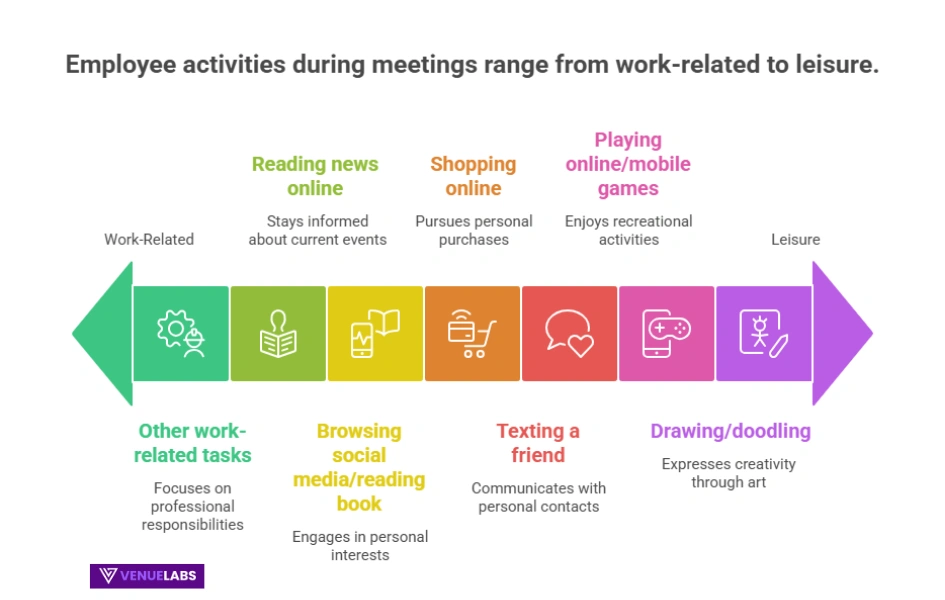
It’s not just about the structure of meetings; it’s also about participant engagement. The reality is, many attendees are not fully present.
- Multitasking Epidemic: A study reveals that 92% of employees unintentionally multitask during meetings, and 41% admit to doing so often or all the time.
- Unrelated Work: Nearly half (49%) of employees admit to doing unrelated work, such as responding to emails (55% in remote meetings), instead of paying attention.
- Daydreaming: Perhaps less surprising, 91% confess to daydreaming during meetings.
- Attention Span Shortfalls: A majority of people have short attention spans. 52% of attendees lose interest in a meeting within the first 30 minutes, and a staggering 96% stop paying attention after 50 minutes.
Table 3: Employee Activities During Meetings (Beyond Paying Attention)
| Activity | Percentage of Employees |
| Reading news online | 39% |
| Browsing social media/reading book | 38% |
| Shopping online | 35% |
| Texting a friend | 32% |
| Playing online/mobile games | 31% |
| Other work-related tasks | 28% |
| Drawing/doodling | 27% |
These behaviors highlight a significant challenge: keeping participants engaged and focused throughout the meeting.
The Virtual Revolution: Pros and Cons
The pandemic accelerated the adoption of virtual meetings, and they are here to stay. However, they come with their own set of advantages and disadvantages.
- Growth Trajectory: Virtual meetings surged from 48% to 77% between 2020 and 2022, and the global video conferencing market continues to grow.
- Employee Preference: Many employees actually prefer virtual meetings. 70% of remote workers find them less stressful, and 71% find it easier to present in a virtual setting. 67% believe they are as productive as in-person sessions.
- Productivity Boost? 43% of professionals believe on-camera meetings enhance productivity, possibly because they reduce multitasking.
- Zoom Fatigue is Real: Despite the benefits, virtual conference fatigue is a significant issue. 49% of respondents claim on-camera meetings are exhausting, and 37.1% consider Zoom fatigue their biggest virtual meeting challenge. Women are 2.5 times more likely to experience it than men, and introverts are more susceptible than extroverts.
- Best Use Cases: 88% of respondents believe video meetings are excellent for training and interviews, but only 53% find them suitable for day-to-day meetings. This suggests a need for discernment in when to go virtual.
The Return of In-Person and the Rise of Hybrid
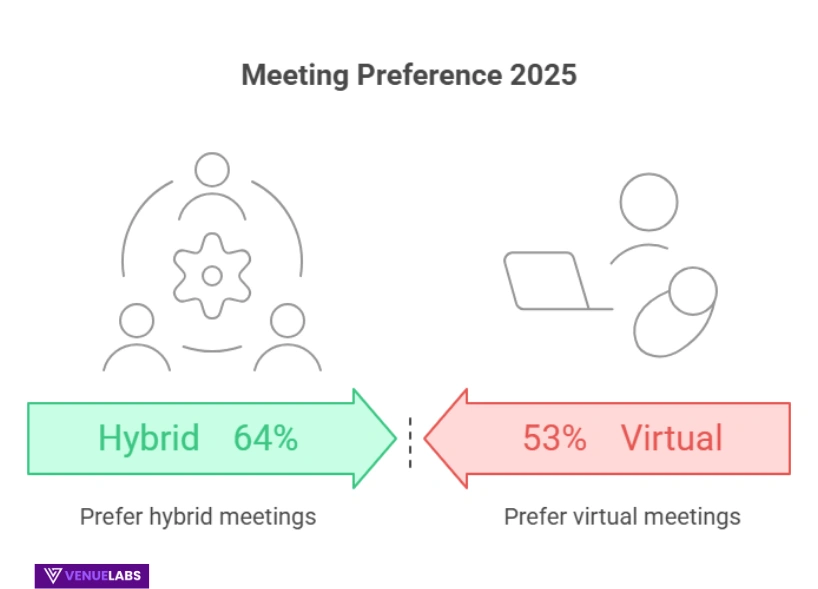
While virtual meetings remain prevalent, there’s a clear resurgence of in-person interactions, leading to a flourishing hybrid model.
- In-Person Comeback: 25% of employees primarily attend in-person meetings. 88% of companies have resumed planning physical events, with 50% prioritizing team-building gatherings.
- Preference Split: While 47% of employees prefer in-person meetings, an almost equal number (53%) prefer virtual. This delicate balance underscores the need for flexibility.
- Hybrid Dominance: 64% of employees who worked remotely during the pandemic now prefer hybrid video conferencing calls. The majority (49%) of professionals attend both online and in-person meetings, indicating that hybrid is the preferred reality for many.
Table 4: Employee Meeting Preferences
| Meeting Type | Percentage of Employees Preferring |
| In-person Meetings | 47% – 50% |
| Online Meetings | 40% – 53% |
| Hybrid Meetings | 64% (among those who worked remotely) |
Also read about: Webinar Statistics 2026
Meeting Logistics: Timing, Attendees, and Agendas
Optimizing meeting logistics can significantly impact their effectiveness.
- Best Day and Time: Tuesday is widely considered the best day for meetings (29% preference), followed by Wednesday (25%). The sweet spot? 2:30 p.m. on Tuesday. Mondays (47%) and Fridays (40%) are the least preferred.
- Ideal Duration: The majority (74.5%) of meetings last 60 minutes or less, with 41.8% falling between 30 minutes and an hour. Shorter meetings (less than 30 minutes) are often more effective.
- The Goldilocks Number of Attendees: Research shows that meetings with 8 or more attendees are more likely to be ineffective. Only 35% of employees believe that fewer attendees equate to more successful meetings. This suggests that a smaller, more focused group is often more productive.
- The Agenda Imperative: As mentioned, only 37% of workplace meetings actively use agendas. This is a critical oversight. A clear agenda is considered very important by 73% of professionals and is cited by 67% as the most important element for effective meetings.
Zoom’s Enduring Influence
Zoom remains a powerhouse in the virtual meeting space, with its statistics reflecting its widespread adoption.
- Market Dominance: Zoom boasts a market cap of $20.47 billion, with nearly 300 million daily meeting participants.
- Versatile Use: 89% of users leverage Zoom for work, 69% for remote meetings, and 63% for connecting with friends and family.
- Customer Base: As of 2022, Zoom served over 509,800 business customers with more than 10 employees.
- Alternatives: If Zoom were unavailable, 50% of users would opt for Google Meet, 16% for Skype, and 15% for Microsoft Teams.
Also read about: Zoom Statistics 2026
Quora and Reddit Insights: What Users Are Asking
Beyond the formal statistics, online forums like Quora and Reddit offer a glimpse into the real-world frustrations and desires of meeting attendees. Common themes include:
- “How do I politely decline unnecessary meetings?” Users are actively seeking strategies to manage meeting overload without offending colleagues.
- “Best tools for asynchronous collaboration to reduce meetings?” The desire for alternatives to live meetings is strong, focusing on tools that facilitate work without requiring everyone to be online simultaneously.
- “Tips for running engaging virtual meetings when everyone is quiet.” Many struggle with low participation in virtual settings and are looking for ways to foster interaction.
- “How to deal with colleagues who dominate meetings?” This recurring complaint highlights issues around meeting facilitation and ensuring equitable participation.
- “What are the best icebreakers for remote teams?” The human element of connection, even in virtual settings, remains a priority for many.
These anecdotal insights reinforce the statistical findings, particularly around meeting overload, the desire for productivity, and the challenges of engagement.
The Future of Meetings: Blended Reality and Smarter Tools
Looking ahead to 2025 and beyond, several trends are shaping the future of meetings.
- Continued Growth: The number of meetings is projected to increase by 11% in 2023, jumping to 34% in the next five years.
- Virtual Endures: Virtual meetings are not disappearing. A SurveyMonkey poll shows 56% of respondents often leave virtual meetings with clear action items, though 32% still feel “this could have been an email.”
- Technological Integration: The future will see a rapid adoption of technology to enhance meetings. 34% of companies will widely adopt virtual reality technology for long-distance meetings within the next five years, aiming to create a more immersive experience. AI-powered tools like AI summarizers and automated note-takers are becoming indispensable.
FAQs About Meeting Statistics
1. What is the average amount of time employees spend in meetings weekly?
On average, 83.13% of employees spend up to one-third of their workweek in meetings, with 4.73% spending 20 hours or more. This amount can vary significantly based on job role and industry.
2. How much money do unproductive meetings cost businesses annually?
Unproductive meetings cost businesses in the United States an estimated $37 billion annually. For larger organizations, this figure can reach hundreds of millions each year.
3. What are the main reasons why meetings are considered unproductive?
The primary reasons for unproductive meetings include a lack of clear objectives, not using an agenda, irrelevant topics, scheduling overload, and insufficient collection of meeting feedback.
4. Do employees prefer virtual or in-person meetings in 2025?
Employee preferences are split, with approximately 47-50% preferring in-person and 40-53% preferring virtual. However, a significant majority (64% of those who worked remotely during the pandemic) prefer hybrid meetings, which combine both elements.
5. What impact will AI and new technologies have on meetings in the coming years?
AI and new technologies are expected to increase meeting efficiency significantly. Tools like AI meeting assistants will provide automated transcriptions, summaries, and action items. Furthermore, virtual reality is projected to be widely adopted by 34% of companies in the next five years to create more immersive long-distance meeting experiences.
Also Read:
- Internet User Statistics
- Semrush AI Statistics
- Google Searches Statistics
- Quora Statistics
- LinkedIn Statistics
Empowering Your Meetings: A Path to Productivity
The statistics are clear: many meetings are ineffective, costly, and a source of frustration. However, when done right, meetings can be powerful catalysts for progress. Here’s how you can transform your meeting culture:
- Be Intentional: Before scheduling, ask: Is this meeting truly necessary? Can this information be conveyed effectively through email, a quick message, or an asynchronous update?
- Define Clear Objectives: Every meeting needs a purpose. State it clearly at the beginning. What do you aim to achieve? What decisions need to be made?
- Create and Share Agendas: This is non-negotiable. A well-structured agenda guides the discussion, keeps everyone on track, and ensures key topics are covered. Share it in advance to allow for preparation.
- Manage Your Guest List: Invite only essential participants. Smaller groups often lead to more focused discussions and quicker decision-making. Consider who truly needs to be there and who can be updated afterward.
- Set Time Limits and Stick to Them: Respect everyone’s time. Defaulting to 30 or 60 minutes isn’t always necessary. Experiment with shorter durations and use a timer if needed. Ending late is a top annoyance.
- Encourage Active Participation: Facilitate discussion, call on quieter attendees, and ensure everyone has a chance to contribute. Combat multitasking by making the meeting engaging.
- Leverage Technology Wisely: Utilize AI meeting assistants to record, transcribe, and summarize meetings. This frees attendees to focus on the conversation, not frantic note-taking, and ensures everyone has access to accurate records.
- Gather Feedback: Periodically solicit feedback on your meetings. What’s working? What’s not? Use this information to continually improve.
- Embrace Asynchronous Communication: For many updates and information sharing, asynchronous tools (like project management software, internal wikis, or dedicated communication platforms) can replace the need for a live meeting, freeing up valuable time for deep work.
By adopting these practices, organizations and individuals can transform their meeting culture from a drain on productivity to a powerful engine for progress.
The future of meetings in 2025 is not about eliminating them entirely, but about making every single one count.
