

The AI Advertising Landscape Is Moving Faster Than Anyone Expected
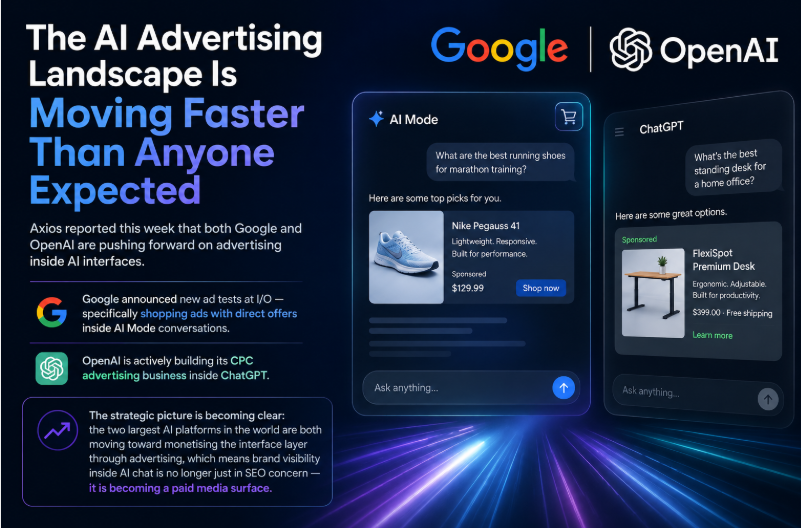
Axios reported this week that both Google and OpenAI are pushing forward on advertising inside AI interfaces. Google announced new ad tests at I/O — specifically shopping ads with direct offers inside AI Mode conversations. OpenAI is actively building its CPC advertising business inside ChatGPT. The strategic picture is becoming clear: the two largest AI platforms in the world are both moving toward monetising the interface layer through advertising, which means brand visibility inside AI chat is no longer just an SEO concern — it is becoming a paid media surface.
What PR and Brand Teams Should Be Doing This Week

For brand reputation teams, the practical implication is direct. As AI interfaces become advertising surfaces, the brands that appear organically in AI-generated answers — through citations, structured data, and authority signals — will be competing alongside paid placements in the same interface. Building organic AI visibility now, before paid placements dominate, is the equivalent of investing in SEO before Google AdWords made every search result a pay-to-play environment.
The specific actions: audit your brand entity data for accuracy across Google Knowledge Graph, Wikipedia, and review platforms. Ensure your most important pages are properly structured with schema markup. And build third-party citation signals — press coverage, industry directory listings, and review platform presence — that AI systems use to evaluate brand credibility before recommending or citing you.
Meta’s Q1 Capex Hit $19 Billion — Up 47% — and It Is All Going Into AI Infrastructure
What Meta Is Actually Building at This Scale
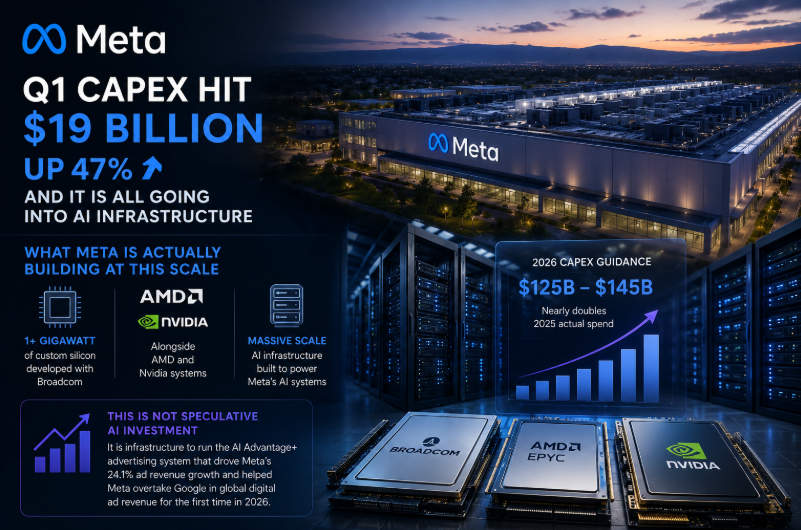
Meta’s Q1 2026 capital expenditure came in at $19 billion — up 46.8% year over year — and the company’s 2026 capex guidance of $125–$145 billion nearly doubles its 2025 actual spend. Zuckerberg told investors Meta is deploying more than one gigawatt of its own custom silicon developed with Broadcom alongside AMD and Nvidia systems.
This is not speculative AI investment — it is infrastructure to run the AI Advantage+ advertising system that drove Meta’s 24.1% ad revenue growth and helped Meta overtake Google in global digital ad revenue for the first time in 2026.
Why This Matters for Social Media and ORM Strategy
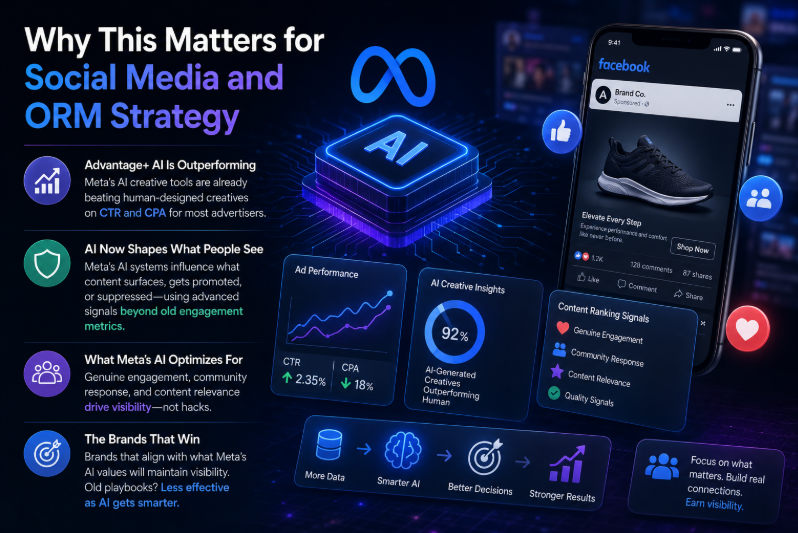
Meta spending $125–$145 billion on AI infrastructure in a single year means its advertising and content systems are about to get significantly more sophisticated. For social media teams, the Advantage+ AI creative tools are already outperforming human-designed creatives on CTR and CPA for most advertisers. For ORM teams, Meta’s AI systems are increasingly influencing what content surfaces in feeds, what gets promoted, and what gets suppressed — based on signals that are harder to game than the old engagement metrics.
The brands that understand what Meta’s AI is optimising for — genuine engagement, community response, and content relevance — will maintain visibility. Those trying to reverse-engineer the algorithm with the old playbook will find it less and less effective as the AI infrastructure underneath the platform becomes more capable.
Quick Links:



Comments
Be the first to leave a comment.