
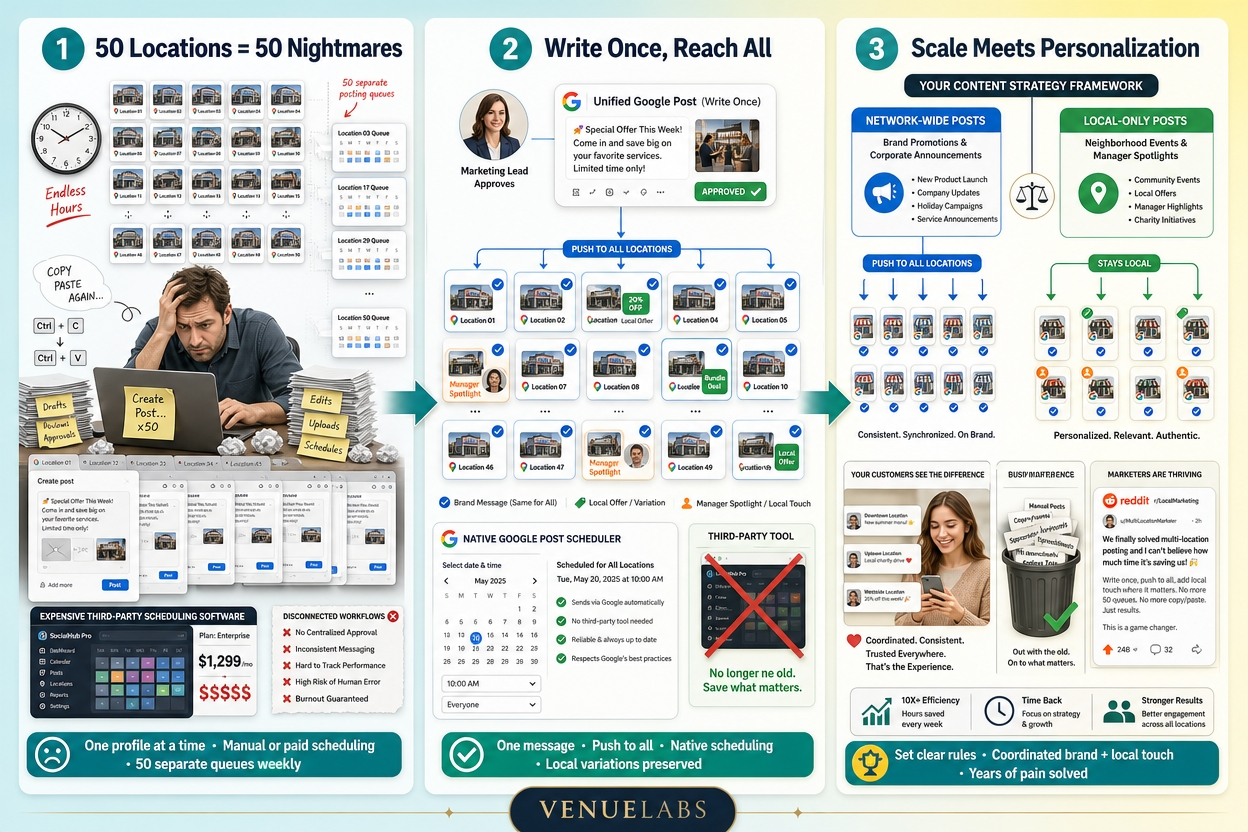
Google Posts can now be scheduled and pushed to every location you manage at once. For the admin work, that’s a straight win. The interesting part is what teams do with it in week two.
For a 50-location franchise, this removes something genuinely miserable: fifty separate posting queues, every week, forever. But the same button that saves those hours can quietly turn fifty local storefronts into one bored corporate megaphone.
What actually shipped
You write one post, pick a time, choose which profiles get it, and it publishes across all of them. No third-party scheduler required. Local variations still work, so a regional offer or a manager spotlight can override the network message on a single profile. We covered the rollout itself when it landed, including the reviewer nickname change that shipped alongside it.
The old way broke teams quietly
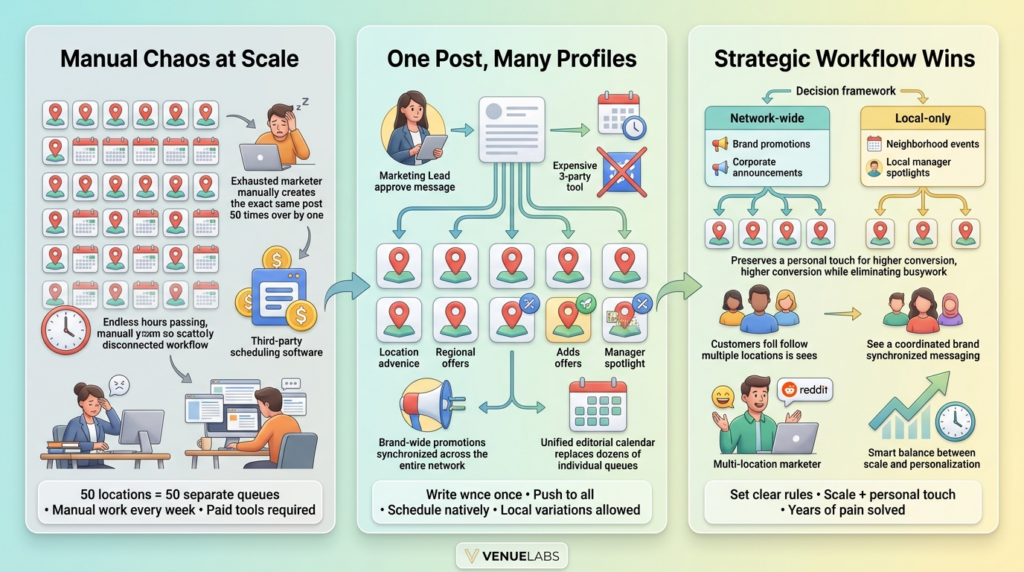
Until now, posts were created one profile at a time, and scheduling meant either manual work or paid software. Do the arithmetic on a 50-location group: one post a week per location is 50 logins, 50 paste operations, and 50 chances to fat-finger a date. That job doesn’t get done badly. It gets deprioritised, then dropped, and the profiles go stale while everyone insists local SEO matters.
Stale profiles are a real cost now that your Business Profile functions as a trust page rather than a directory listing. An empty Posts tab reads as a business that stopped paying attention.
The trap nobody’s warning you about
Here’s the catch. The moment publishing to 50 profiles costs the same as publishing to one, the incentive flips. Every post becomes a network post, because why wouldn’t it be? Six weeks later every location is running identical copy, the local flavour is gone, and engagement quietly sags.
Our take: the value of this feature isn’t the uniformity it enables. It’s the hours it frees up, and those hours should go straight back into location-specific content. Use the time you saved on the boring network announcements to write the neighbourhood posts you never had capacity for. Centralise the admin, not the voice.
A split rule worth stealing
Before you schedule anything, write down which content is network-wide and which is location-only, then hold the line. This is the version we’d start from:
| Publish network-wide | Keep local |
|---|---|
| Brand promotions and seasonal campaigns | Staff spotlights and new hires |
| Policy or hours changes affecting every site | Neighbourhood events and local partnerships |
| New product or menu launches | Location-only hours, parking, access notes |
| Awards and company milestones | Photos of that actual building and team |
The test is simple: if a customer standing outside one specific location wouldn’t recognise the post as being about that place, it’s a network post. If they would, it stays local and a human at that site writes it.
Rebuild the workflow this month
Rebuild the process now, while the feature is new and nobody has formed lazy habits around it. Four moves, in order:
- Agree the split rule above with whoever owns brand, and write it somewhere both head office and location managers can see.
- Build a single editorial calendar for the network posts, scheduled a month ahead. That’s the part this feature actually solves.
- Give each location a standing slot, say one local post a fortnight, and make it someone’s named job rather than a shared aspiration.
- Review after 90 days. If every profile looks identical, the rule failed and the local slot is being skipped.
Worth measuring properly, too. Now that Business Profile connects to GA4, you can see which posts actually moved calls and direction requests instead of guessing from the engagement numbers in the dashboard.
Questions multi-location teams are asking
If you were paying for one purely to schedule Google Posts and push them to several locations, probably not. If you rely on approval workflows, cross-network scheduling, or reporting that spans Google, Facebook and Instagram together, the third-party tool still earns its licence.
Yes, and this is the part worth protecting. Local variations are still allowed, so a site manager can publish a neighbourhood event or an offer that only applies to their location without head office overriding it.
Consistency beats volume. A predictable rhythm you can actually sustain, such as one network post a week plus one local post a fortnight, keeps the profile active without turning into busywork that gets abandoned in month two.
Anything naming a specific staff member, address, car park, neighbourhood event, or location-only opening hours. Broadcasting those to every profile is how a chain ends up advertising a Tuesday quiz night at a branch that doesn't run one.
The publishing route is new, but the content rules are not. The same policies apply to a scheduled network post as to a manual one, and Google now explains rejections in more detail than it used to.
The teams who get value from this won’t be the ones posting the most. They’ll be the ones who decided, on purpose, what deserves to go everywhere and what belongs to one street. Set the rule this week, then spend the time you save on the local landing pages that now feed the same rankings.



Comments
Be the first to leave a comment.