

Reviews have always mattered for local businesses. But the way those reviews influence customer decisions in 2026 is changing, and there is a meaningful gap between venues that understand this and venues that are leaving visibility on the table.
Most venue owners know they need Google reviews. Fewer understand that the reviews sitting on their own website — testimonials, curated feedback, case studies — can be made machine-readable through schema markup, which directly increases the chance of those reviews appearing as rich snippets in search results and being cited in AI-generated answers.
Content with proper schema markup has a 2.5x higher chance of appearing in AI-generated answers. Structured data acts as a translation layer between your content and AI systems — rather than forcing AI to parse meaning through natural language processing, schema provides explicit signals about what your content represents.
For reviews specifically, the AggregateRating schema tells search engines your average rating, the number of reviews contributing to it, and the scale it is rated on. When a potential customer asks an AI search engine about venues in your category, systems that can verify your rating through structured data are far more likely to include you in the response.
The trust multiplier
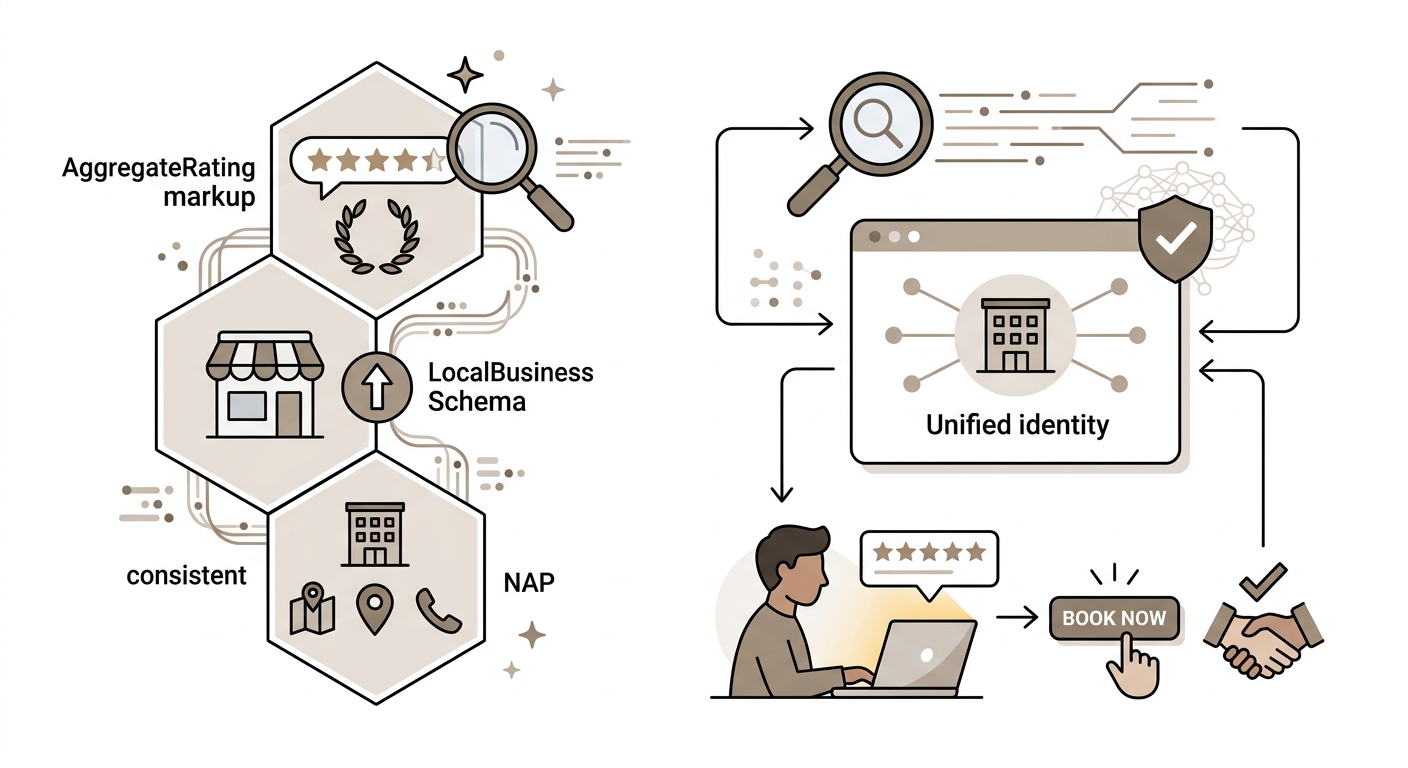
Reviews marked up with schema are not just about search visibility. They are about trust signals stacking on top of each other. A venue with clean LocalBusiness schema, verified AggregateRating markup, and consistent NAP (name, address, phone) data across the web is presenting a coherent identity to both search systems and potential clients. That coherence translates directly to booking confidence.
In an AI search landscape where source trust determines citation selection, entity disambiguation is the most important SEO investment available. Schema that accurately describes genuine content and clearly identifies your organization as a disambiguated entity is the foundation of both visibility and trust strategies.
The practical step here is straightforward. If you have a testimonials or reviews section on your venue website, implement AggregateRating and Review schema on those pages. Ensure it accurately reflects real data — AI systems and Google’s quality algorithms are increasingly good at detecting inflated or misrepresented ratings.
Combining on-site reviews with third-party verification
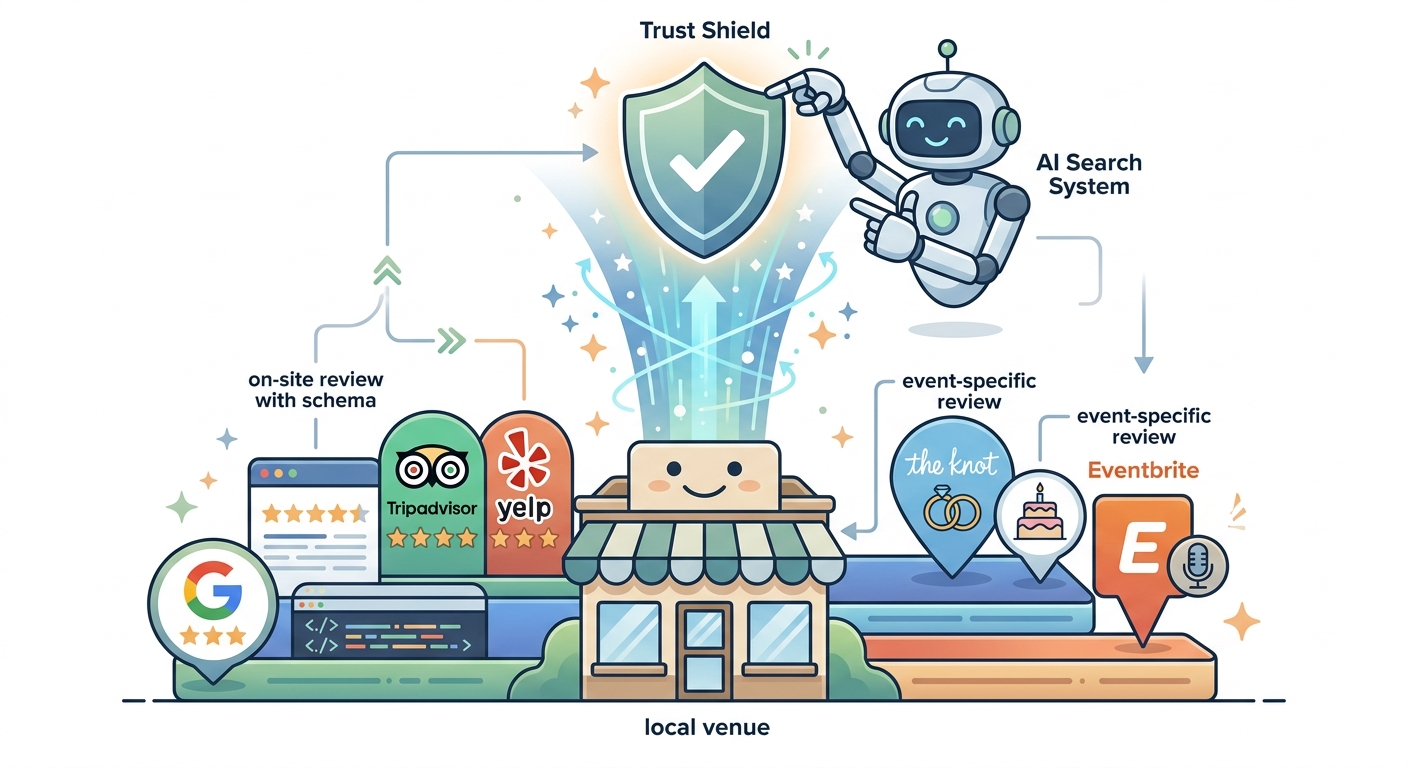
The strongest local venue presence in 2026 layers multiple trust signals: Google Business Profile reviews, on-site reviews with schema, Trip advisor or Yelp presence for applicable venue types, and event-specific reviews from platforms like The Knot or Eventbrite where relevant.
None of these individually is decisive. All of them together — especially when the on-site data is properly structured — create a reinforcing signal that makes it very hard for AI search systems to overlook your venue when it matches a customer query.
💬 Reddit signal: r/smallbusiness has active threads this month from venue owners who installed review schema after noticing competitors showing review stars in search results while their own listings showed nothing. Several owners report significant increases in click-through rates within weeks of implementing the markup correctly.
🐦 Twitter/X signal: Local marketing consultants on X regularly share screenshots of venue listings in AI search results. The consistent observation: venues showing structured review data are appearing in AI-assembled recommendation lists. Venues without it are not, even when their actual review scores are higher.
If your reviews are not marked up, a significant portion of their value is invisible to the systems your future customers are using to find you. That is a fixable problem, and fixing it is one of the most direct ROI improvements available to local businesses right now.
Quick Links:



Comments
Be the first to leave a comment.